Göran Persson
Social Democratic Party leader and Prime Minister of Sweden 1996–2006, succeeding Ingvar Carlsson and presiding over a decade of fiscal consolidation that restored public-finance credibility after the early-1990s crash. Author of the post-1997 surplus rule (the "Persson doctrine") and the 1998–1999 cross-party pension reform that converted Sweden's public pension to a notional defined-contribution model.
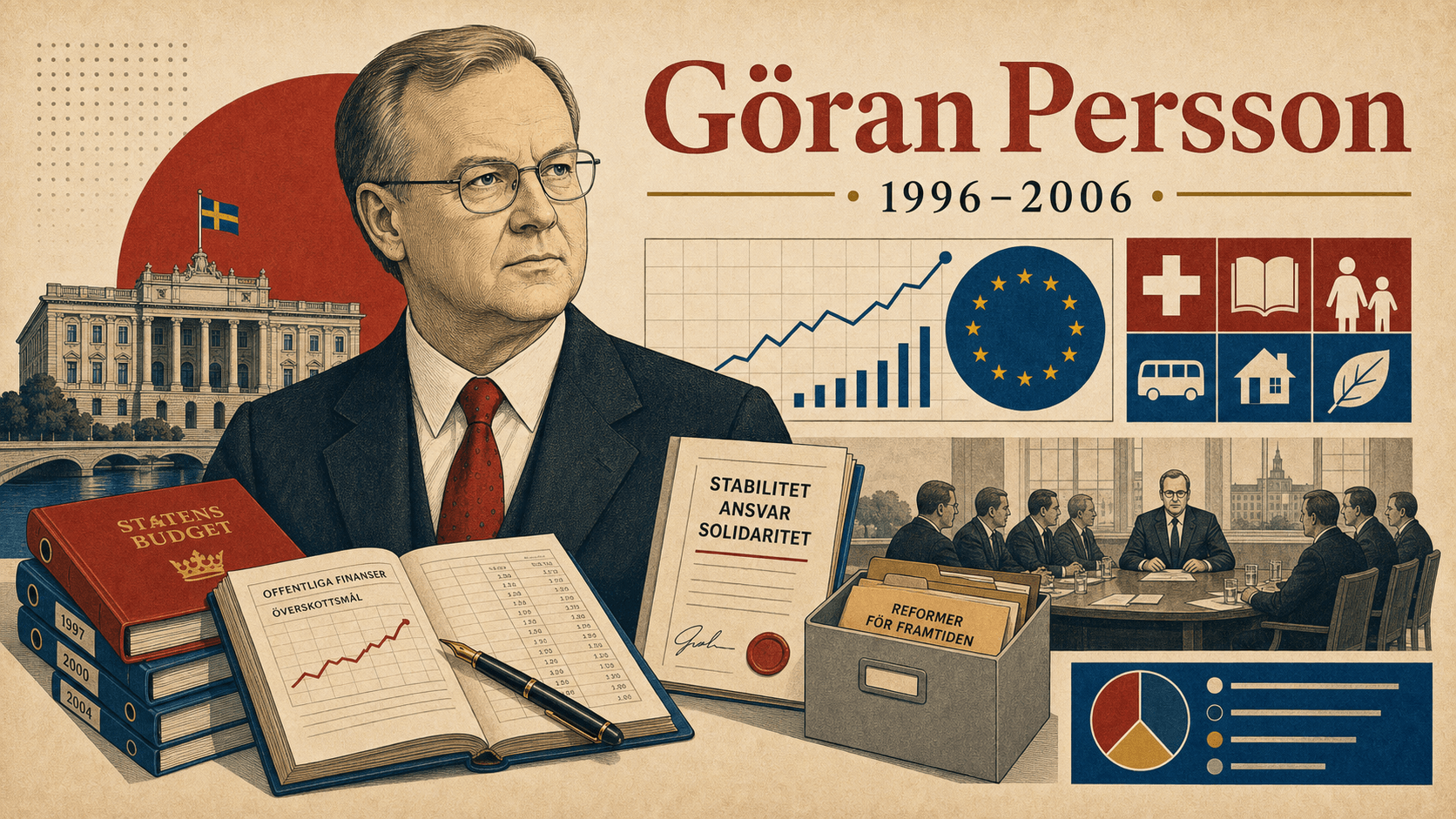
Göran Persson took over S and the premiership in March 1996 mid-term, after the Toblerone scandal derailed Mona Sahlin’s expected succession to Ingvar Carlsson. He inherited a country still climbing out of the 1991–1993 banking crisis and used a decade in office to make sure Sweden never returned to the fiscal exposure of the early 1990s.
The defining instrument was the post-1997 surplus rule — a 2% structural budget surplus over the business cycle, often called the Persson-doktrinen — anchored rhetorically in the line “den som är satt i skuld är icke fri”: the one who is in debt is not free. That doctrine has outlived every Persson successor and shaped Swedish welfare-state politics longer than any single piece of legislation he passed. The 1998–1999 pension reform extended the same logic into the social-insurance core: a cross-party deal converted the public pension from a defined-benefit pay-as-you-go system to a notional defined-contribution model designed to absorb demographic and growth shocks automatically rather than through political renegotiation.
Persson’s foreign-policy decade — 2001 EU presidency, the 9/11 era, the Iraq war, and the September 2003 euro referendum that rejected single-currency adoption days after the assassination of foreign minister Anna Lindh — falls outside the source corpus consulted for this page and is left as a research gap; the public site links here from the relevant year pages until that material is back-filled. He left office in October 2006 after losing to Fredrik Reinfeldt’s Alliance.