Fredrik Reinfeldt
Moderate prime minister of Sweden 2006–2014 who built the four-party Allians för Sverige coalition, rebranded the right around the work-line (arbetslinjen) and successive earned-income tax credits, and steered the country through the 2008 financial crisis before losing the 2014 election to Stefan Löfven.
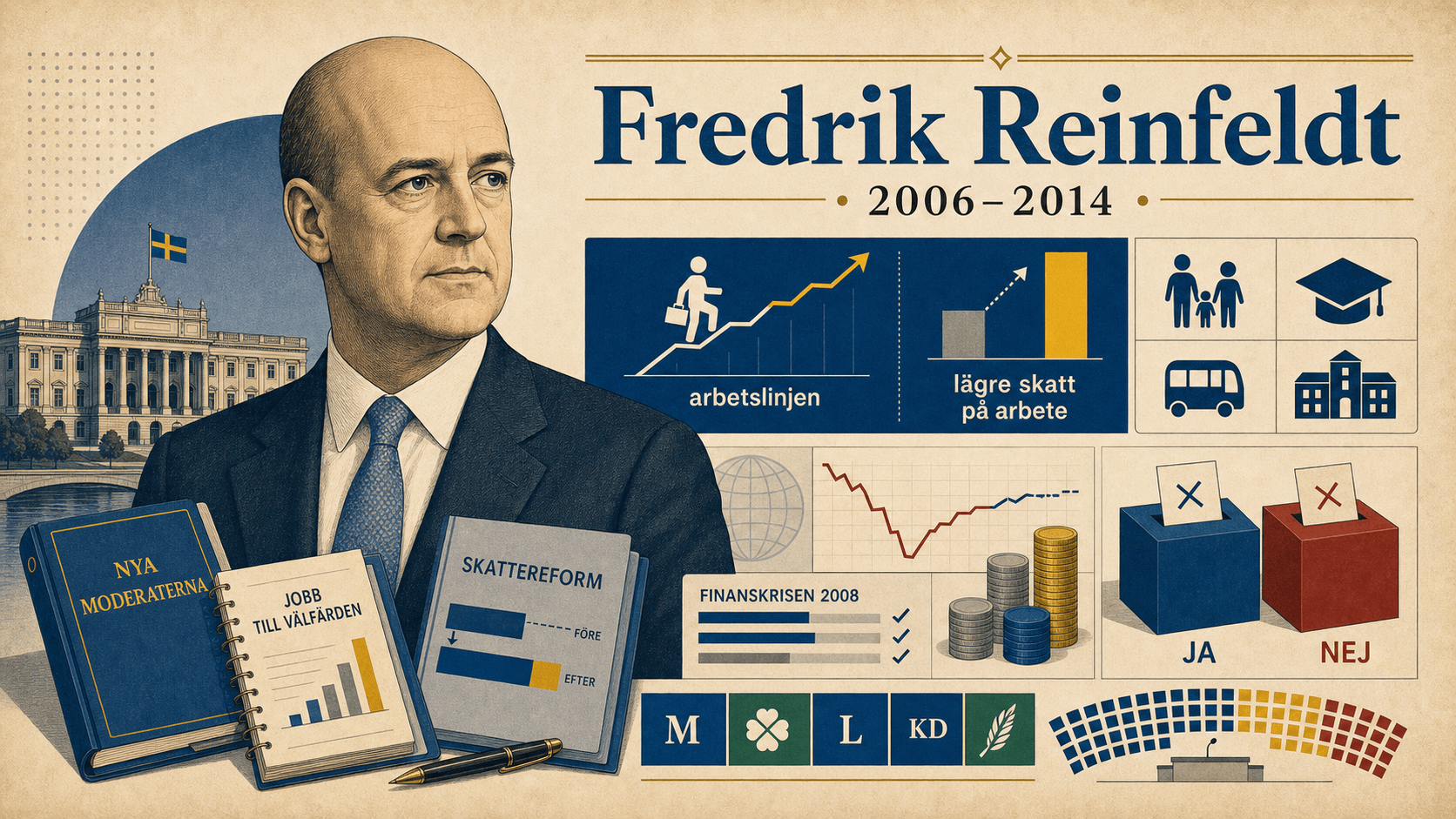
Fredrik Reinfeldt led Sweden as prime minister from 6 October 2006 to 3 October 2014, the head of Regeringen Reinfeldt — the centre-right Alliansregeringen of the Moderates, the Centre Party, the Liberals, and the Christian Democrats. The coalition had been launched as Allians för Sverige on 30 August 2004 to make the centre-right governable as one bloc, and it took office with a majority before continuing as a minority cabinet after the 2010 election.
His domestic project rebuilt Moderaterna around the arbetslinjen — the “work-line” — and a sequence of jobbskatteavdrag earned-income tax credits intended to lower the marginal cost of taking work. In retrospect this was less a stand-alone reform than a long ideological reframing: a centre-right governing under a vocabulary borrowed from the historic labour movement. The 2008 FRA law extended Sweden’s signals-intelligence regime and remained politically contested for years, eventually drawing scrutiny from the European Court of Human Rights.
The Reinfeldt era ended in two acts. In August 2014 he asked Swedes to open their hearts to refugees, and in September the Alliance lost the Riksdag election. He resigned the day after the vote, and the following month Stefan Löfven took over a Sweden whose tax base, migration regime and political map had all been reshaped by his eight years.