Tage Erlander
Sweden's longest-serving prime minister (1946-1969), leader of the Social Democratic Party across 23 years that built out the Folkhemmet welfare state, passed the ATP supplementary-pension system in 1959 by a single vote, launched the Million Programme in 1965, kept Sweden out of NATO and out of nuclear weapons, and handed power to Olof Palme in 1969.
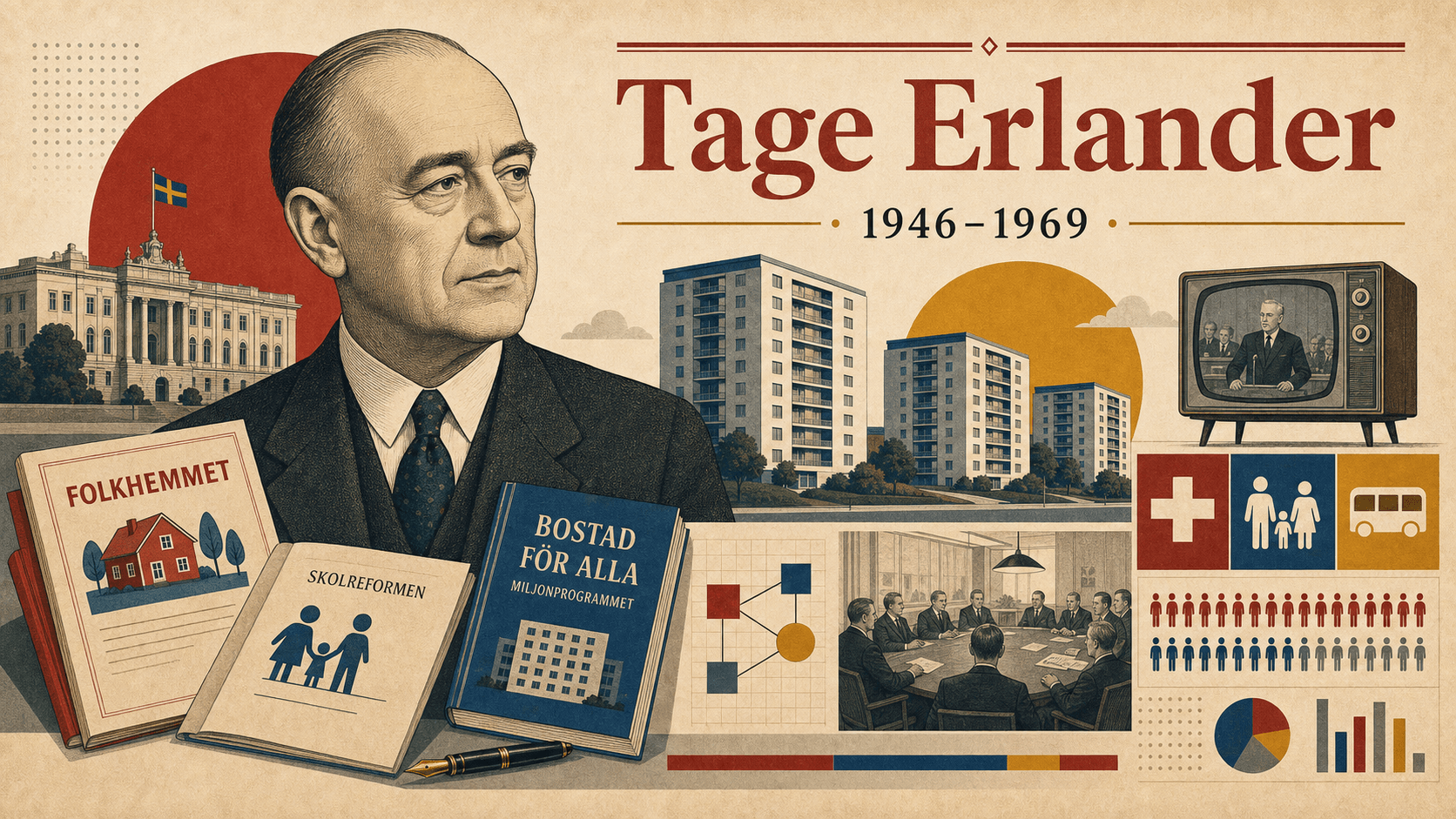
Tage Erlander led Socialdemokraterna for 23 years — from October 1946 to October 1969 — the longest tenure of any Swedish prime minister. He inherited the office on the sudden death of Per Albin Hansson, governed first alone, then in a 1951 coalition with Bondeförbundet, then alone again from 1957, and stepped down on his own terms after a 50.1% landslide in 1968. His real signature was institutional: a welfare state that grew without nationalising the economy, held together by what he called “the strong society.”
The Erlander years built the post-war Folkhemmet in concrete and statute. National basic pension and child allowance laws passed in 1947, alongside the rollout of free universal healthcare. The fight over a mandatory state-administered supplementary pension (ATP) broke the coalition with the Centre Party in 1957, triggered the last snap election in Swedish history in 1958, and was carried in 1959 by a single Liberal defector’s vote. From 1965 the Million Programme set out to build one million homes in ten years.
Foreign policy ran along a narrow ridge. Erlander defended a strict non-alliance line through the Cold War while privately acknowledging an “ideological affinity with the Western democracies”; Sweden built a heavy conventional military but signed the Nuclear Non-Proliferation Treaty in 1968. The 1963 Wennerström espionage affair, the 1967 Dagen H switch to right-hand traffic, the 1967 unicameral-Riksdag agreement, and Sweden’s growing public opposition to the Vietnam war all sit inside this arc.
Erlander’s other long bequest was the cohort he hired around himself — “the boys” (pojkarna), among them Olof Palme (personal secretary from 1953), Ingvar Carlsson, and Bengt K. Å. Johansson. That cohort, more than any single reform, decided what Swedish social democracy would look like for the next twenty years. On 14 October 1969 Erlander handed the premiership to Palme, having quipped earlier to President Kekkonen that Palme would “never” succeed him because “he is far too intelligent for a Prime Minister.”
Sources
- Tage Erlander — WikipediaTier C
- Olof Ruin, Tage Erlander - Serving the Welfare State, 1946-1969 — University of Pittsburgh PressTier D
- Folkhemmet — WikipediaTier C
- Million Programme — WikipediaTier C
- 1957 Swedish pensions system referendum — WikipediaTier C
- Olof Palme — WikipediaTier C
- History of Sweden — WikipediaTier C