1968
Left bloc · SPalme's torchlight march triggers a US–Sweden diplomatic crisis.
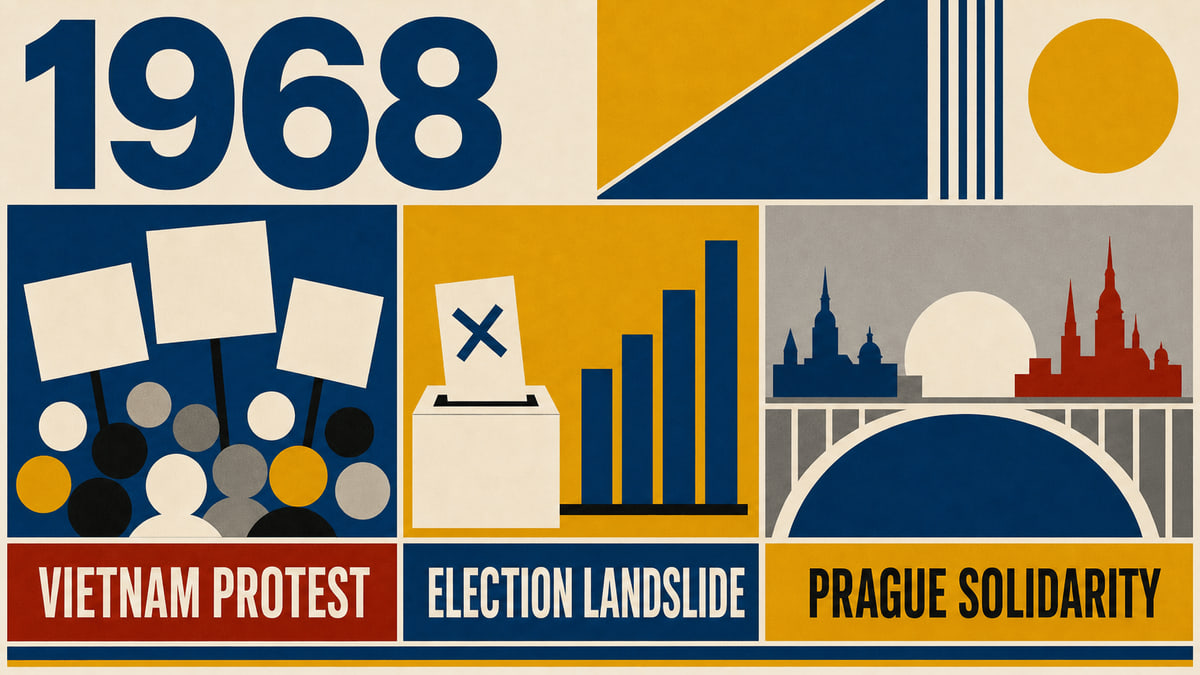
1968 infographic: Vietnam protest, election landslide, and Prague solidarity
AI-generated infographic using the page's 1968 anchors.
Highlights
- Vietnam protest: On 21 February 1968, Cabinet Minister Olof Palme marched in a Stockholm torchlight demonstration against the Vietnam War alongside the North Vietnamese ambassador to the Soviet Union. The United States recalled its ambassador from Sweden in response — a dramatic rupture for a nominally neutral country.
- Social Democratic landslide: The 15 September general election gave the Social Democrats an outright parliamentary majority, one of their strongest results ever, reflecting broad public support for the welfare state despite the foreign-policy controversy.
- Prague Spring solidarity: After the Soviet-led invasion of Czechoslovakia in August, Swedish civil society formed a solidarity committee for Czechoslovakia — a consistent expression of Sweden's non-aligned moral stance throughout the Cold War.
Events in this year
1965-1974 Million Programme 1965 In 1965 the Riksdag adopted the Million Programme — a plan to build one million dwellings in Sweden over ten years. By 1974 roughly one million homes had been built; Olof Palme oversaw the project as Minister of Communications. It became, relative to population, the largest housing programme in the world at its time and the third corner of post-war Folkhemmet alongside 1947 welfare reforms and 1959 ATP. Reform 1967-1968 Unicameral Riksdag Agreement and Abolition Vote 1967–1968 In March 1967 the four established parliamentary parties agreed to replace Sweden's bicameral Riksdag with a directly-elected unicameral chamber. On 17 May 1968 the First Chamber voted to abolish itself by 117 to 13. Sweden became fully unicameral from 1971, the constitutional turning point that prepared the way for the 1974 Instrument of Government. Reform