Olof Palme
Twice Prime Minister of Sweden — 1969 to 1976 and 1982 to 1986 — Olof Palme massively expanded the welfare state, rewrote the constitution, and pushed an aggressively non-aligned foreign policy that froze relations with Washington. He was assassinated on Sveavägen in 1986, an unsolved national trauma that still shapes the Swedish political imagination.
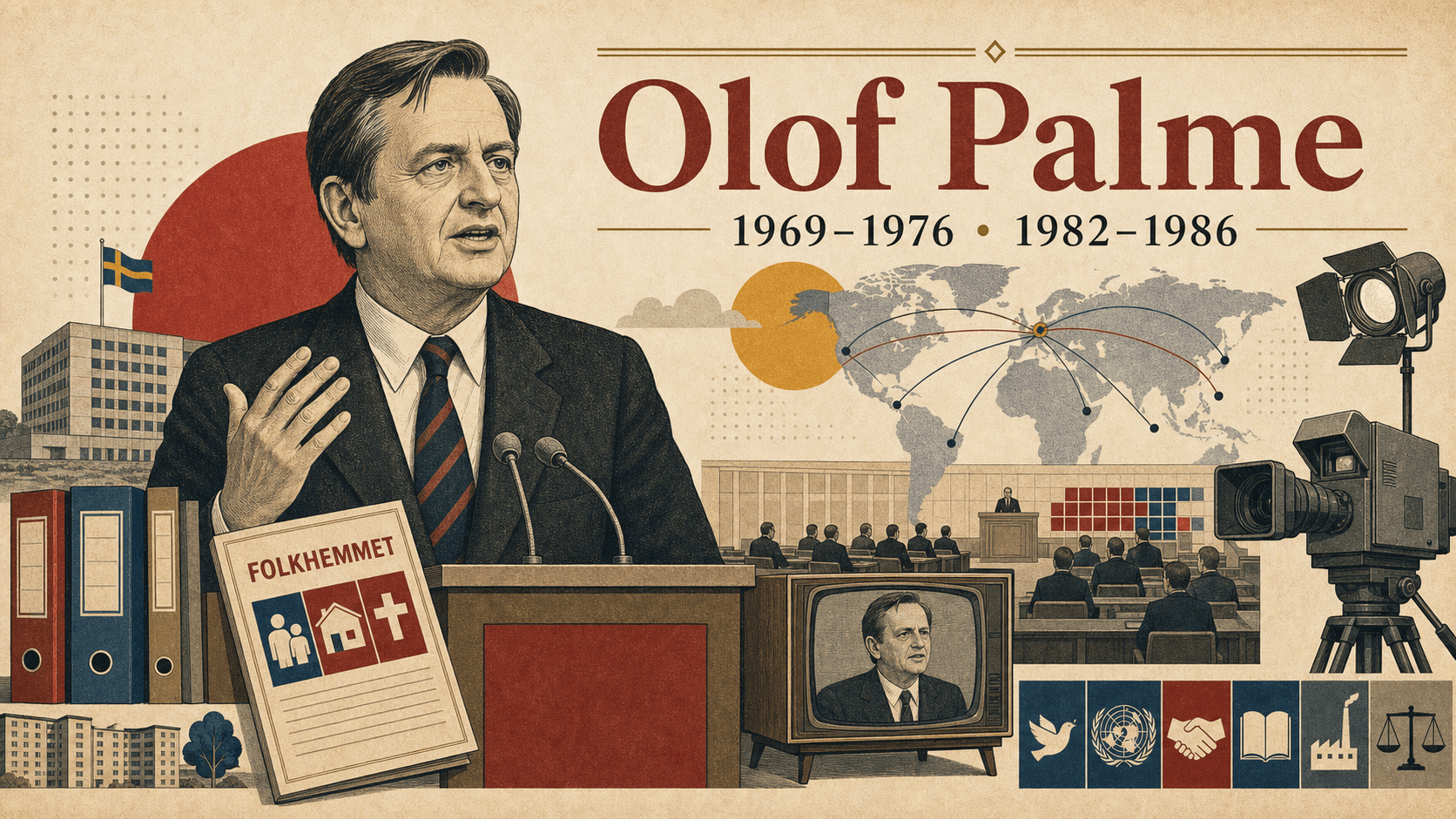
Olof Palme inherited the premiership from Tage Erlander on 14 October 1969 and remade Sweden in two waves. His first cabinet (1969–1976) abolished bicameralism, replaced the 1809 Instrument of Government, rolled out universal dental insurance, and turned the country into a vocal critic of the United States during the Vietnam War — most sharply with the 1972 Hanoi-bombings condemnation that froze diplomatic relations with Washington. The same period opened the Socialdemokraterna-LO debate over the wage-earner funds, the proposal that defined the next decade of class conflict.
His second cabinet (1982–1986) returned to office after six years of bourgeois rule, devalued the krona to restore export profitability, and formally introduced the wage-earner funds in 1983 — the trigger of an unprecedented 100,000-strong business-community protest in Stockholm on October 4. The same years brought the Hårsfjärden submarine incident in 1982 and a UN mediation role in the Iran–Iraq war. His foreign policy framed Sweden as a small state with global moral standing, a posture that admirers called principled and detractors called provocation.
On 28 February 1986 Palme was shot at close range while walking home from a cinema on Sveavägen. The investigation became the largest single-event criminal probe in modern Swedish history, recorded in the public inquiry SOU 1999:88, and remains formally unsolved. The succession passed within hours to his deputy Ingvar Carlsson, but the rupture of that night still organises how Swedes remember the politics of the 1980s.