1938
Left bloc · SSaltsjöbaden Agreement shapes Swedish labor relations for decades.
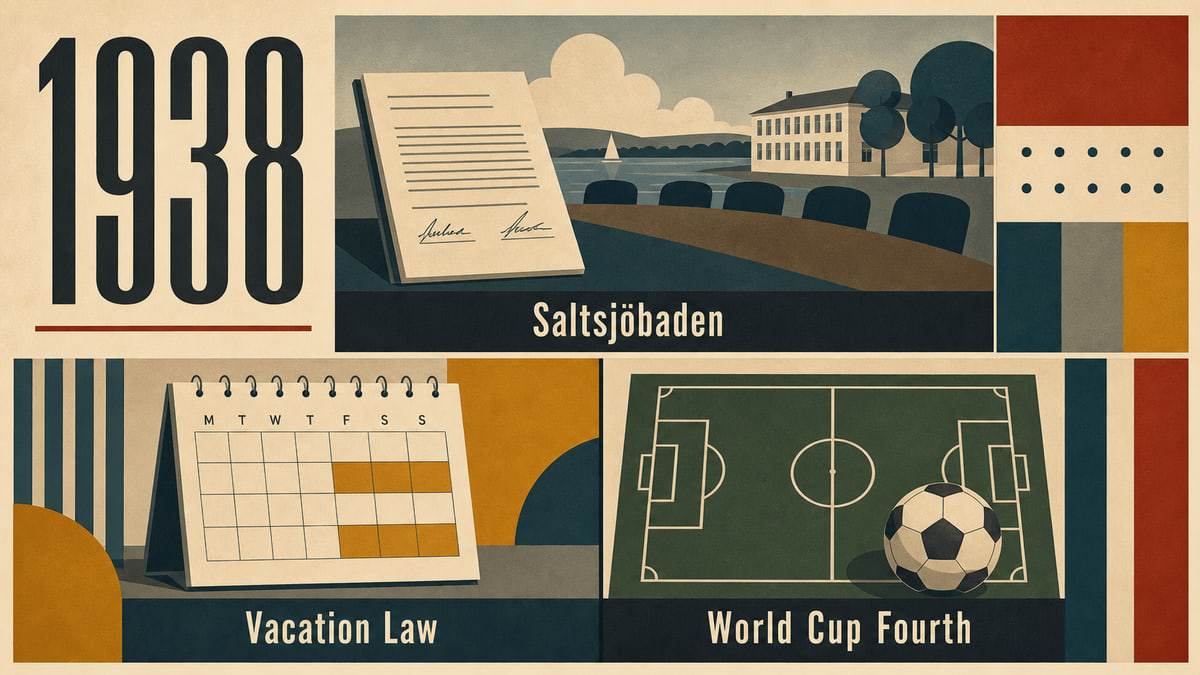
1938 infographic: Saltsjöbaden, Vacation Law, World Cup Fourth
Codex imagegen orientation image using the page's 1938 anchors: Saltsjöbaden, Vacation Law, World Cup Fourth. Generated image, not source evidence.
Highlights
- Saltsjöbaden Agreement signed: On 20 December 1938, LO and SAF concluded a landmark collective agreement at the Grand Hotel Saltsjöbaden, establishing self-regulation of the labor market without state intervention — the cornerstone of the Nordic model.
- Peace obligation: The agreement imposed a binding 'peace obligation' on both sides, created mechanisms to suspend disruptive strikes, and launched the cooperative 'Saltsjöbaden spirit' that defined Swedish industrial relations until the late 1960s.
- Defence budget climbs: With Nazi Germany annexing Austria and the Sudetenland, Swedish military spending reached USD 58.6 million; coastal and border fortification work accelerated.
Events in this year
1938 Sweden finishes fourth at the 1938 FIFA World Cup Svenska Fotbollförbundet records Sweden finishing fourth at the 1938 World Cup in France, behind Italy, Hungary, and Brazil. The tournament path included an 8-0 win over Cuba and losses to Hungary and Brazil. Sports 1938-07-01 Vacation law 1938 The 1938 vacation law entered into force on 1 July 1938 and made paid vacation a statutory part of Swedish working life. Later parliamentary material describes the original minimum as two weeks for covered year-round workers, while SCB connects the reform to Sweden's growing leisure geography. Reform 1938-12-20 1938 Saltsjöbaden Agreement On 20 December 1938 the Swedish Trade Union Confederation (LO) and the Swedish Employers Association (SAF) signed a master collective agreement at the Grand Hôtel Saltsjöbaden outside Stockholm. Negotiated under the shadow of a government threat to legislate, the pact established rules for industrial action and a joint Labour Market Board, and inaugurated the "Saltsjöbaden spirit" of peak-level self-regulation that anchored the Swedish Model of industrial relations for the next four decades. Reform