Per Albin Hansson
Social Democratic Prime Minister of Sweden across four cabinets between 1932 and 1946 — the central architect of the *folkhemmet* ("people's home") frame, the 1933 cross-class crisis agreement with the Farmers' League, the 1938 Saltsjöbaden labour-market settlement, and Swedish wartime neutrality. Died in office on 6 October 1946.
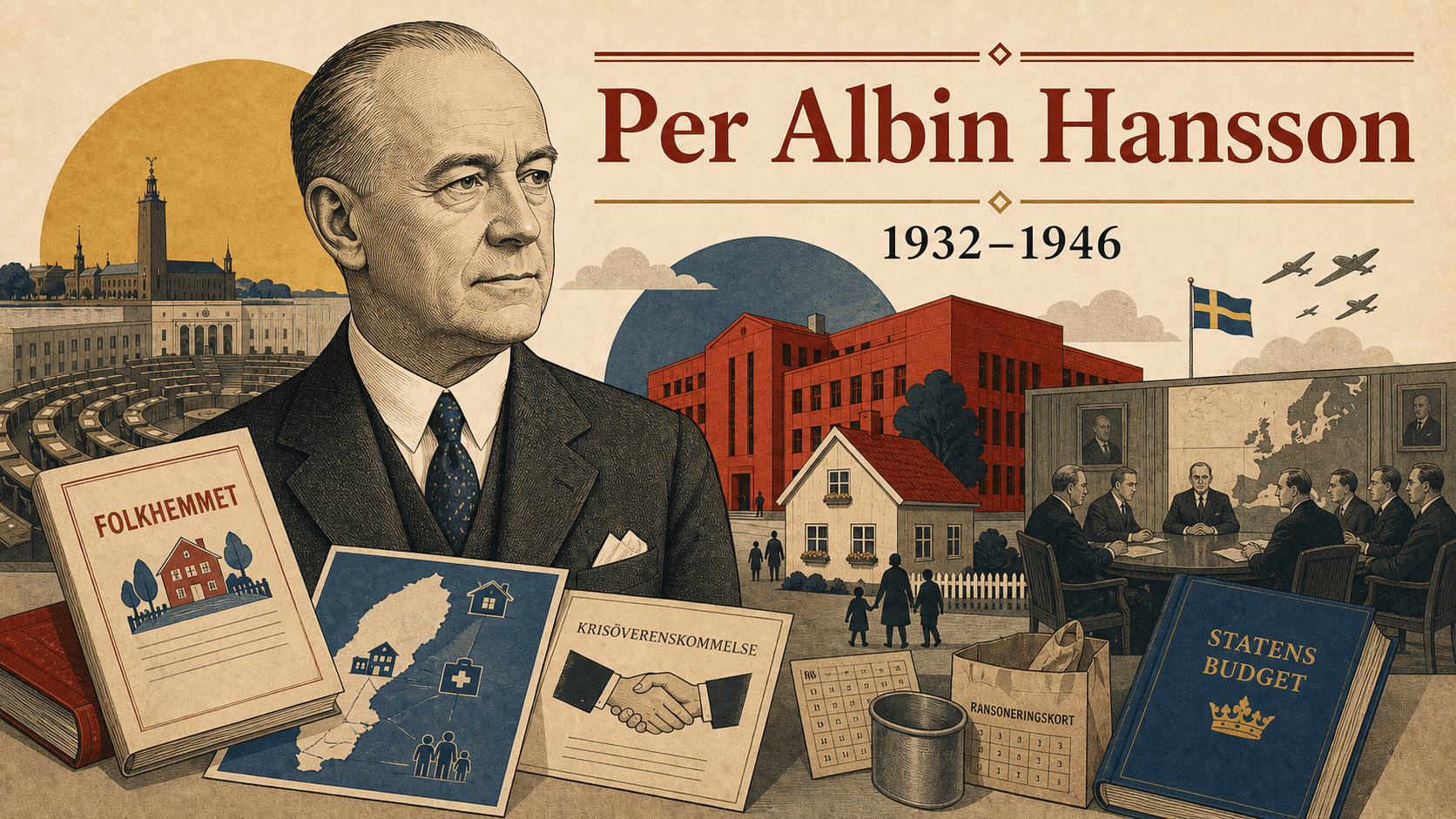
Per Albin Hansson governed Sweden across four Socialdemokraterna cabinets between 1932 and 1946 — Hansson I (1932–1936), Hansson II in coalition with the Farmers’ League (1936–1939), Hansson III as a wartime National Unity government with the Communists excluded (1939–1945), and Hansson IV after liberation (1945–1946). He is the central architect of the folkhemmet — the “people’s home” idea that reframed Swedish society as a national family marked by equality and mutual responsibility.
His decisive moves came early. In 1933 he negotiated the kohandel (“cow trade”) crisis agreement with Centerpartiet‘s historic predecessor Bondeförbundet, exchanging Keynesian public works for agricultural price supports and isolating the era’s extreme political movements. In 1938 the Saltsjöbaden Agreement between LO and SAF set the self-regulating norm of the Swedish labour market that would underwrite the post-war model. From 1939 he held Sweden out of the Second World War while running a national coalition and a major rearmament programme — a posture tested in the 1941 Midsummer Crisis when his cabinet allowed transit of the German 163rd Infantry Division.
Hansson is the figure on whom the long Social Democratic dominance of mid-century Sweden hinges; his sudden death in office on 6 October 1946 cleared the way for Tage Erlander and the post-war “record years” that built out the welfare state his coalitions had only sketched.