Centerpartiet (C)
Centerpartiet (Centre Party, C), founded 1913 as Bondeförbundet and renamed Centerpartiet in 1957, is Sweden's historical agrarian and centrist party; it led the three Fälldin cabinets of 1976–1982, served as coalition partner under Bildt 1991–1994, sustained both Löfven cabinets through Decemberöverenskommelsen and Januariavtalet, and sits in opposition in the 2022–2026 mandate.
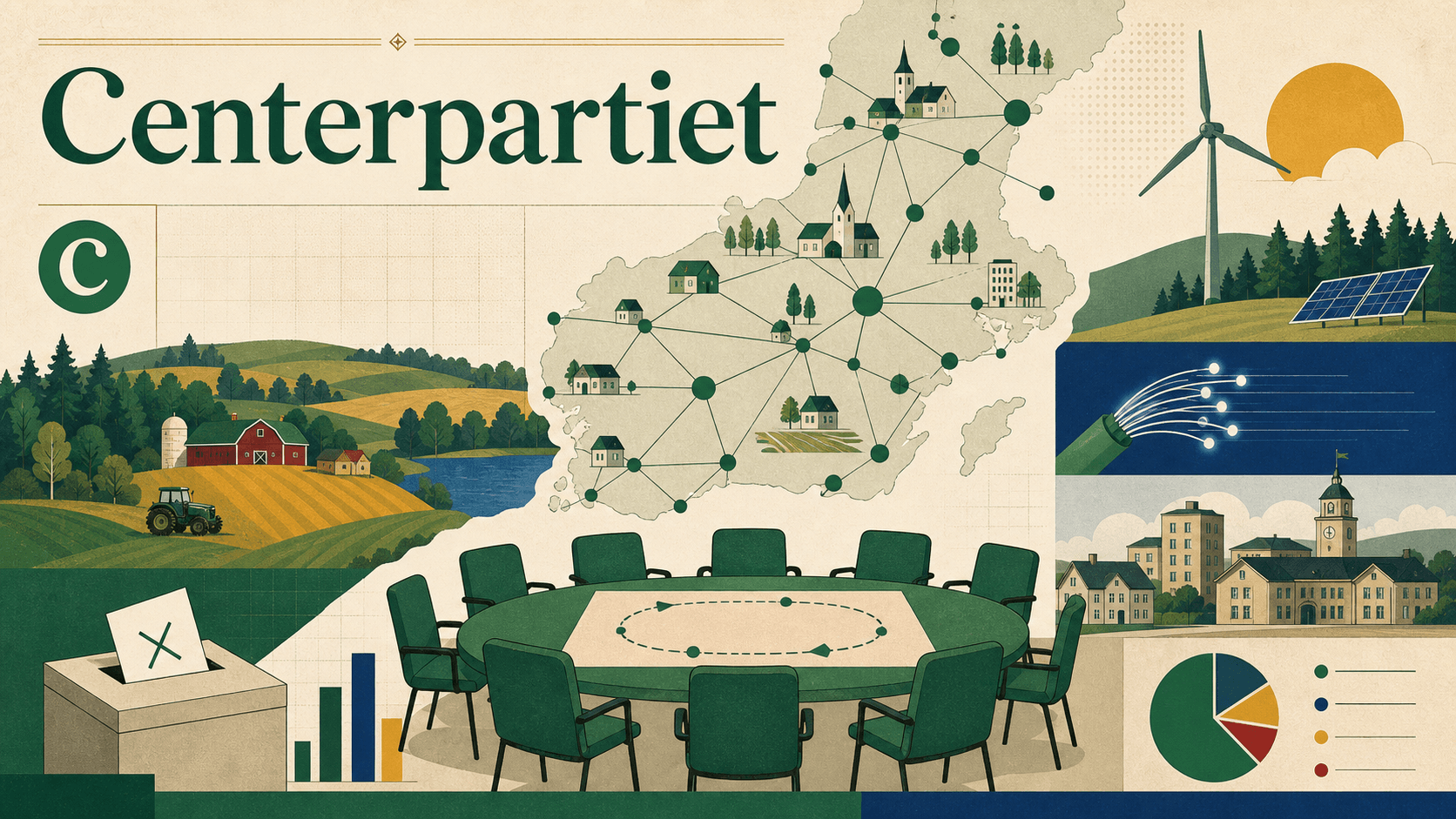
Centerpartiet (C) is Sweden’s historical agrarian and centrist party, founded in 1913 as Bondeförbundet (Farmers’ League) and renamed Centerpartiet in 1957 as it broadened beyond a purely rural constituency. Across the twentieth century the party functioned as the centrist hinge of Swedish politics: agrarian coalition partner of the Social Democrats in 1936 and 1951, and lead party of the three Fälldin cabinets of 1976–1982 that ended 44 years of unbroken social-democratic rule. The party also sat in Carl Bildt‘s coalition cabinet of 1991–1994.
In the 2014–2022 mandate the party twice broke its bloc to keep Sverigedemokraterna out of government — first through the Decemberöverenskommelsen (December Agreement, 2014) and then through the Januariavtalet (January Agreement, 2019) with S, MP and L that sustained Stefan Löfven‘s second cabinet through passive support.
After the 2022 election the party moved into opposition outside the Tidö Agreement. In February 2023 long-serving leader Annie Lööf stepped down and was succeeded by Muharrem Demirok. Ideologically the 2022–2026 mandate is defined by social-liberal economic policy, decentralisation, green-economy investment, and an anti-SD line that distinguishes C from the rest of the former Alliance.
The deep value: staying relevant
The Centre Party stopped being the farmers’ party it grew from long ago — and ever since, what it guards most is its own indispensability: the seat at the table where things get decided. For that it will give up almost any single position, however emblematic it sounds.
The clearest case is the 2009 nuclear deal: a party whose decades-long fight against nuclear power was its calling card (the 1981 programme bluntly demanded that “kärnkraften skall därför snarast avvecklas”) gave it up for the sake of Alliance unity. The same logic runs through its swings between blocs: to stay at the levers, C carried a left government through the 2019 January Agreement, then stood outside Tidö in 2022. One thing it held firm — the line against SD; everything else was tradeable. This is a reading, not a neutral fact; for the full frame, see the essay power or principle.