Carl Bildt
Moderate Party leader and Prime Minister of Sweden 1991–1994, leading a four-party centre-right coalition supported in the Riksdag by the populist newcomer Ny Demokrati. His cabinet drove the most aggressive market-liberal turn since the post-war settlement — school vouchers, the Securum bad-bank resolution of the 1991–1993 banking crisis, and the EEA-then-EU accession track.
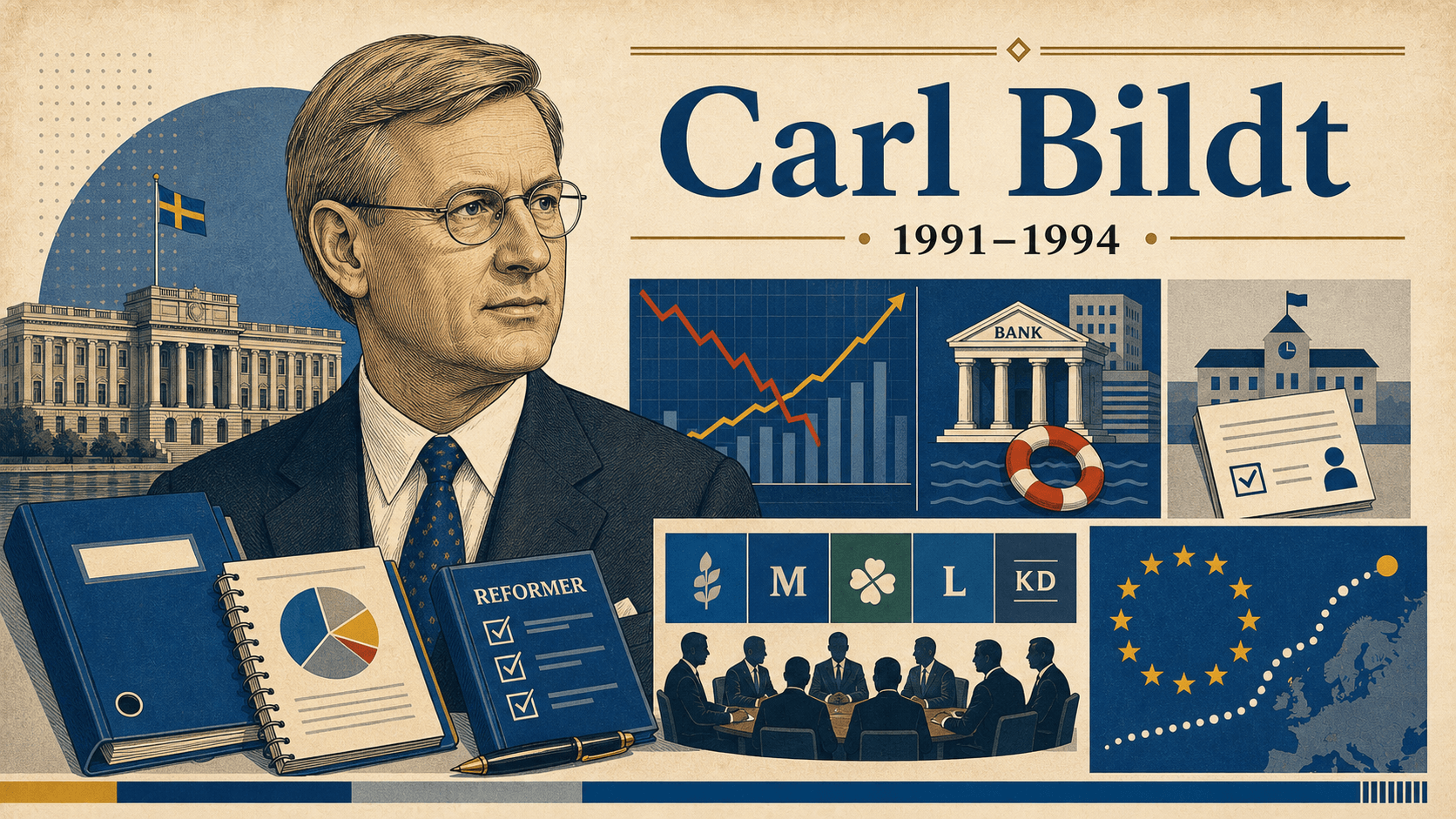
After the centre-right won the September 1991 election, Carl Bildt formed a four-party minority cabinet — M, FP, C, KD — that depended for its parliamentary majority on the newcomer right-populist party Ny Demokrati. The constellation broke 1980s norms about who could anchor a Riksdag majority and set the tone for a government willing to shift the post-war settlement decisively rightwards.
The Bildt years were dominated by two crises and one strategic reorientation. The 1991–1993 banking and real-estate crash forced the creation of 1992‘s state-owned bad bank, Securum, which absorbed distressed assets from Nordbanken — later cited internationally as a model resolution but, at the time, a deeply costly intervention. In parallel, the Friskolereformen of 1992 opened tax-funded competition from privately-operated, including for-profit, independent schools — a structural change to Swedish education whose long-run effects on equivalence and segregation remain politically contested two decades later. The Bildt cabinet did not invent Swedish neoliberalism, but it institutionalised it inside the welfare-state core in a way no earlier government had attempted.
The third arc was European. Bildt’s government signed the EEA agreement in 1992 and conducted the EU accession negotiations whose outcome — a 52.74% Yes in the November 1994 referendum — was confirmed under the incoming social-democratic cabinet. By the time he handed power back to Socialdemokraterna in October 1994, Sweden’s institutional alignment with continental Europe was already irreversible.
Sources
- 1991 Swedish general election — WikipediaTier C
- Securum — WikipediaTier C
- 1994 Swedish European Union membership referendum — WikipediaTier C
- The school voucher system – efficiency and consequences (RiR 2022:17) — RiksrevisionenTier A
- Financial Crisis and Crisis Management in Sweden — Lund UniversityTier B