1992
Right bloc · MThe 500% interest rate defence fails: Sweden floats the krona on 19 November.
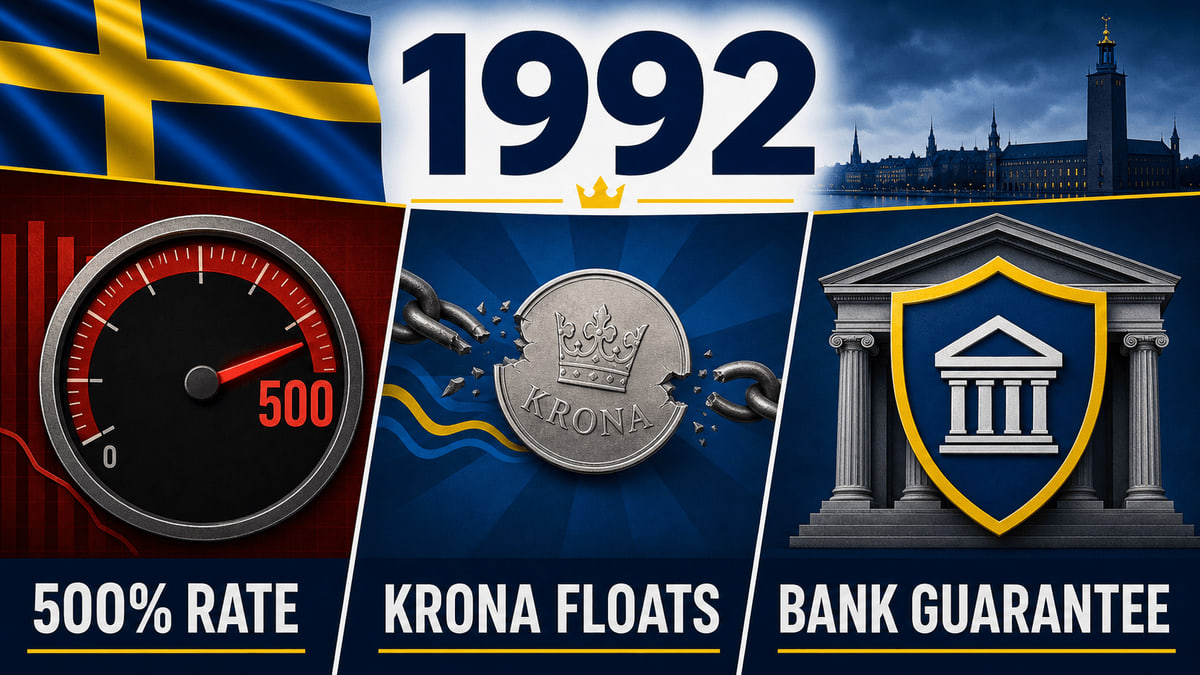
1992 infographic: The 500% interest rate defence fails: Sweden floats the k…
AI-generated infographic using the page's 1992 anchors.
Highlights
- 500% marginal rate: On 16 September, with currency speculators attacking the krona's ECU peg, the Riksbank set its marginal lending rate at 500% — the highest in Swedish peacetime history — in a bid to make short-selling unprofitable.
- Krona floated: The defence collapsed on 19 November; the Riksbank abandoned the fixed exchange rate and the krona quickly depreciated around 20%, eventually boosting export competitiveness.
- Bank nationalisation: Gota Bank failed and was merged into state-owned Nordbanken. The government guaranteed all deposits at Sweden's 114 banks and established a bank support board; total cost reached 64 billion kronor.
Events in this year
1992 1992 School Voucher Reform (Friskolereformen) In 1992 the Bildt cabinet legislated a universal school voucher (skolpeng) that let tax-funded, privately operated and for-profit independent schools compete with municipal schools on equal terms. Combined with the 1991 municipalisation of schools, the reform turned one of the OECD's most centralised education systems into one of its most decentralised. Reform 1992 Securum Bad Bank (1992) In December 1992 the Swedish state founded Securum, a state-owned asset-management company that absorbed about 67 billion SEK of distressed real-estate loans from the partly state-owned Nordbanken. Designed with McKinsey using lessons from the US Resolution Trust Corporation, Securum became the globally cited model for systemic banking-crisis resolution and held the final fiscal cost within roughly 2 percent of GDP. Reform 1991-1993 Swedish Banking Crisis 1991–1993 Following the November 1985 financial deregulation, the Swedish real-estate bubble burst from autumn 1990. The Bildt cabinet issued a general bank-obligations guarantee, created the Securum bad bank, and let the krona float on 19 November 1992. GDP fell 5.1 percent over 1991–1993 and total net fiscal cost stayed near 2 percent of GDP, making the Swedish response a globally cited template for systemic banking resolution. Crisis 1992-11-19 Krona Float — 19 November 1992 After raising the marginal overnight interest rate to 500 percent on 16 September 1992 in a failed defence of the pegged krona, the Riksbank allowed the currency to float on 19 November 1992 during the European ERM crisis. The krona depreciated about 9 percent immediately and 20 percent by year-end. The float ended Sweden's fixed-exchange regime and led to the 1993 2-percent inflation target and 1999 central-bank independence. Reform