Thorbjörn Fälldin
Centre Party leader who broke four decades of unbroken Social Democratic government in 1976, Thorbjörn Fälldin served as Prime Minister 1976–1978 and again 1979–1982 across three cabinets. Nuclear-power conflict, the 1980 nationwide strike-and-lockout known as Storkonflikten, the 1980 nuclear referendum, and the 1981 U 137 Soviet submarine grounding defined his tenure.
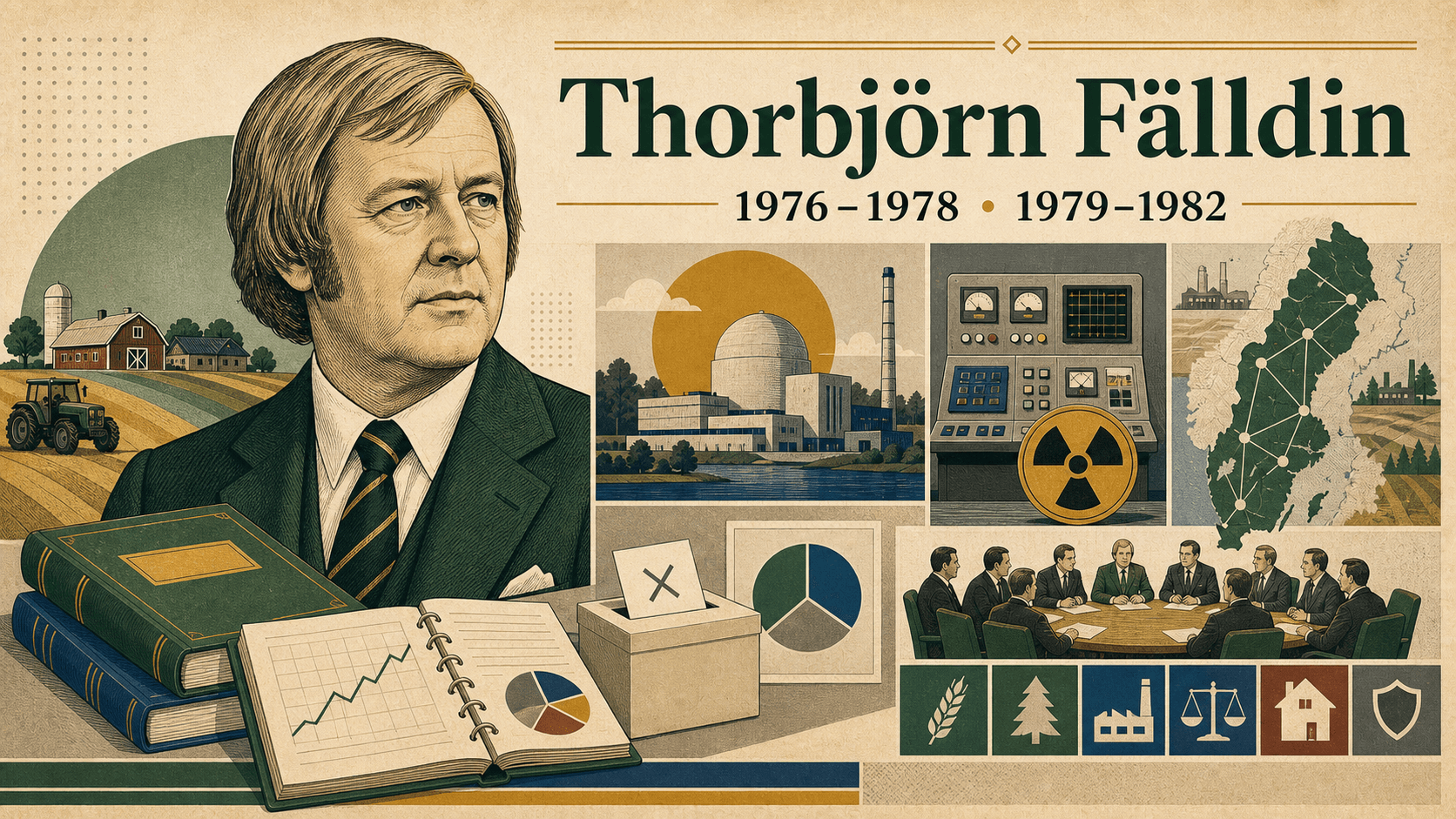
Thorbjörn Fälldin became Prime Minister on 8 October 1976 at the head of a Centre / Liberal / Moderate coalition — the first non-socialist government in Sweden in over four decades. The Fälldin I cabinet kept the Keynesian welfare model running through global recessions but collapsed on 18 October 1978 when the three coalition parties failed to agree on nuclear power. Liberal deputy Ola Ullsten took the premiership for one year while Centerpartiet regrouped.
Fälldin returned to office in 1979 and led two further cabinets through one of the most turbulent stretches of post-war Swedish politics. The 1980 1980 Storkonflikten saw LO and TCO unions face SAF in a nationwide strike and lockout after his cabinet failed to deliver an acceptable settlement. The same year the multi-option referendum on nuclear power on 23 March set the long path to phase-out. The 1981 U 137 incident — a Soviet submarine running aground in the Karlskrona archipelago — pulled the cabinet straight into a Cold War security crisis.
The Fälldin years are now read less as a clean ideological break than as the moment Sweden’s bourgeois bloc proved it could govern but could not yet hold together. The cabinets pivoted from Keynesian stimulus to austerity in 1980–1982, and at the 1982 election Olof Palme returned Socialdemokraterna to power.