1980
Right bloc · CNuclear referendum and Sweden's biggest-ever labour lockout reshape the decade.
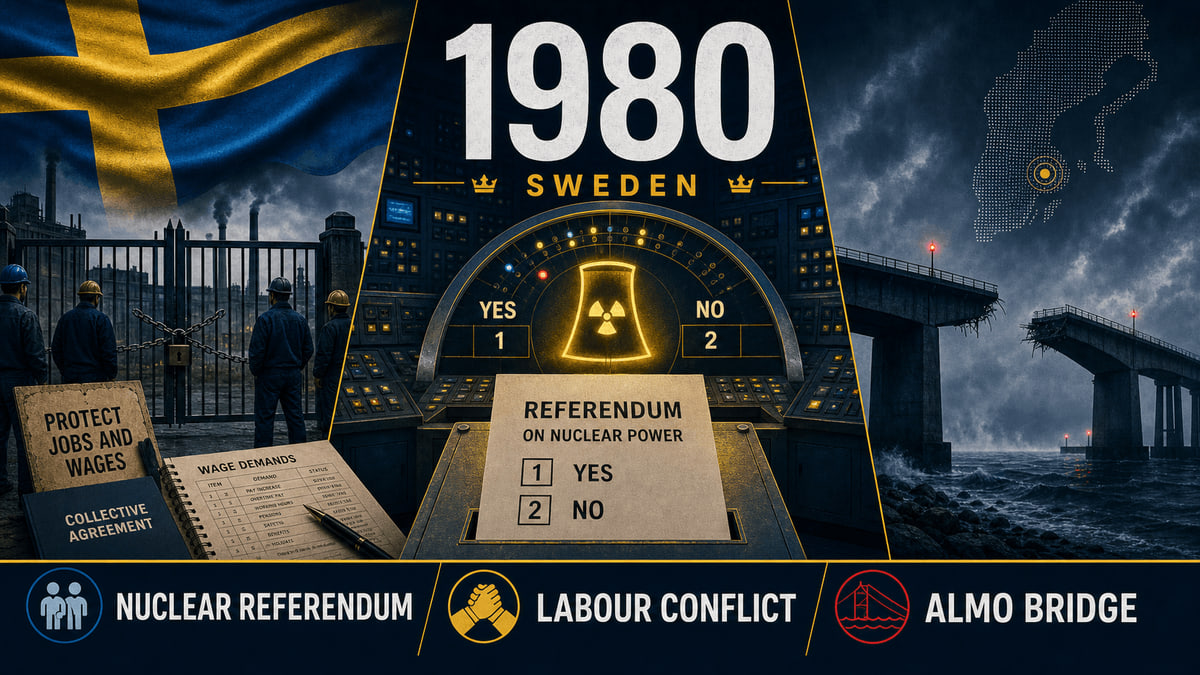
1980 infographic: nuclear referendum and labour conflict
AI-generated infographic using the page's 1980 anchors.
Highlights
- Nuclear referendum: On 23 March 1980, Sweden held its only referendum on nuclear power. Option 2 — gradual phase-out by 2010 while keeping existing reactors — narrowly won with 39.1% of votes, shaping energy policy for a generation.
- Storkonflikten: From 25 April to 12 May, Sweden experienced its most intense labour conflict since 1909: roughly 100,000 workers struck and 700,000 were locked out (≈19% of the workforce). The employers' confederation ultimately capitulated to union wage demands.
- Almö Bridge collapse: On 18 January, the freighter Star Clipper struck a support of the Almöbron bridge to Tjörn in fog, killing eight people as cars drove off the broken section. The accident accelerated construction of a replacement bridge.
Events in this year
1980 1980 Great Conflict (Storkonflikten) In spring 1980 the largest labour conflict in modern Swedish history erupted between the LO and TCO trade-union confederations and the SAF employers' confederation. Triggered when the Fälldin II cabinet failed to present an incomes package acceptable to low-income earners, the dispute escalated through a coordinated SAF lockout under chairman Curt Nicolin and re-set Swedish wage formation for the rest of the 1980s. Crisis 1980-03-23 1980 Nuclear Power Referendum On 23 March 1980 Sweden held a non-binding three-option national referendum on the future of nuclear power. Voters narrowly chose Line 2 — a gradual phase-out compromise framed by the Social Democrats and Liberals — over Line 3's rapid phase-out backed by the Centre and Left parties. The result settled, for a time, a cleavage that had toppled the Fälldin I cabinet in 1978, while the long-term reality drifted closer to Line 1. Referendum