Vänsterpartiet (V)
Vänsterpartiet (Left Party, V), founded 1917 as Sveriges socialdemokratiska vänsterparti and successively renamed through Sveriges kommunistiska parti, Vänsterpartiet kommunisterna, and Vänsterpartiet in 1990, is Sweden's left-socialist party; it served as passive support for both Löfven cabinets, triggered the 2021 no-confidence vote, and sits in opposition in the 2022–2026 mandate.
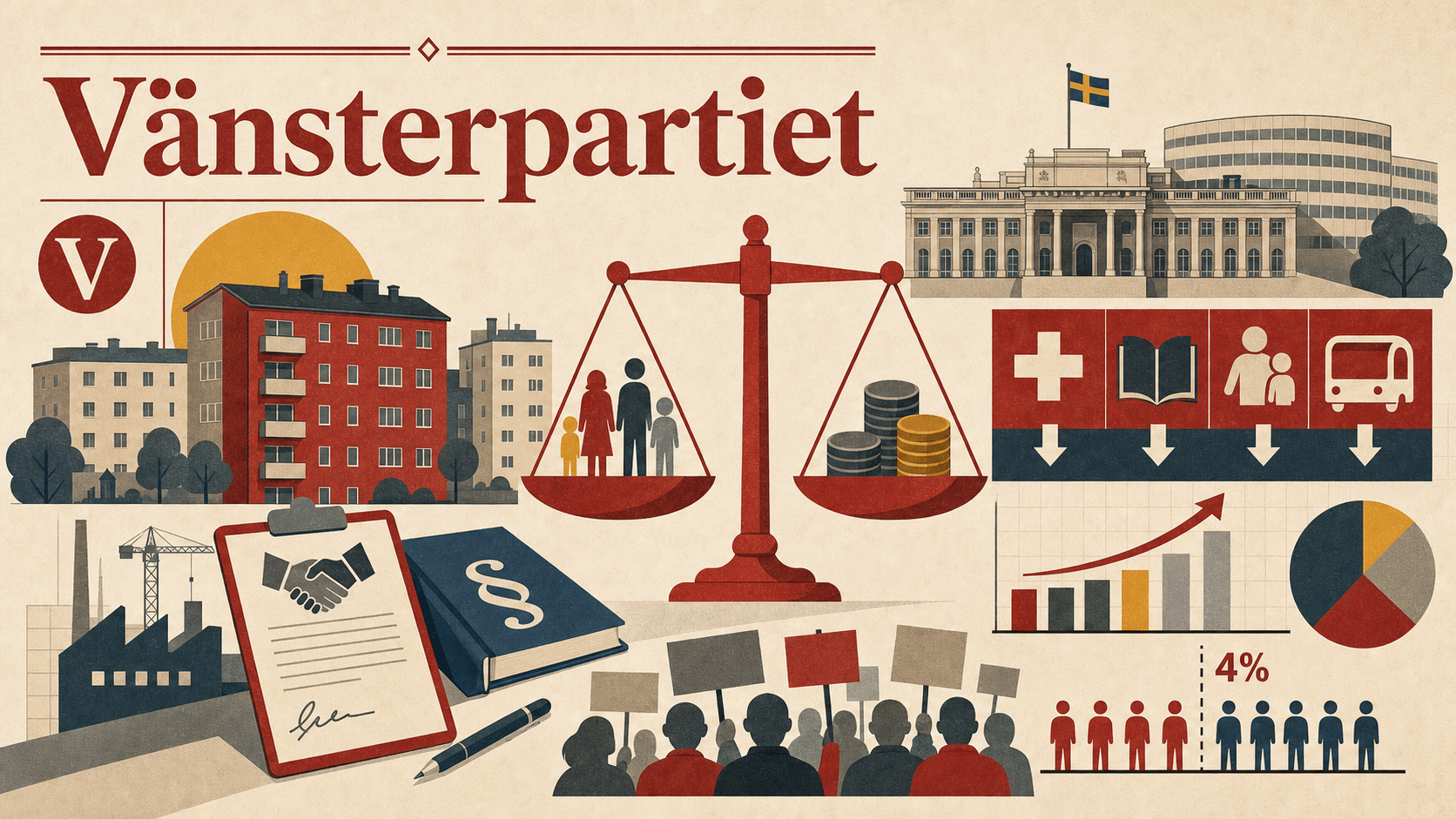
Vänsterpartiet (V) is Sweden’s left-socialist party, founded in 1917 as Sveriges socialdemokratiska vänsterparti in a left split from the Social Democrats. The party was renamed Sveriges kommunistiska parti in 1921, Vänsterpartiet kommunisterna in 1967, and finally Vänsterpartiet in 1990 when it dropped the communist label after the collapse of the Eastern bloc. The 1990 rebranding marks the formal break with the Soviet-aligned tradition and the reorientation toward a left-socialist, feminist, ecological programme.
Across the post-1976 mandate cycle the party did not enter cabinet but served as an indispensable parliamentary support party for left governments. It functioned as passive support for both Stefan Löfven minority cabinets — Löfven I from 2014 to 2018 and Löfven II from 2019 to 2021 — and in June 2021 it triggered the vote of no confidence that brought down Löfven II over a housing-market deregulation clause in the Januariavtalet.
After the 2022 election the party sits in opposition. Under leader Nooshi Dadgostar, who succeeded Jonas Sjöstedt in October 2020, V’s 2022–2026 platform is built on opposition to Tidö-driven migration restriction and law-and-order reforms and on a left-pacifist criticism of the 2022 NATO turn that distinguishes it from a pro-Russian framing.
The deep value: principle above power
If power sits beneath M‘s doctrine, then beneath the Left Party’s — in mirror image — sits principle. Not to dirty itself with power, to stay the “conscience of the left,” is the party’s face. For decades V propped up Social Democratic governments without entering cabinet and without trading itself for ministerial seats.
The clearest case is the no-confidence vote of June 2021. When Löfven’s government moved toward market-rate rents that threatened the system of affordable housing, Dadgostar drew a red line — and the party brought down its own government, saying it had “stood by its word.” The 2022 vote against NATO, when almost everyone else turned, belongs here too. Where power bends the principle for others, for V the principle topples the power. This is a reading, not a neutral fact; for the full frame, see the essay power or principle.