Ingvar Carlsson
Twice Prime Minister of Sweden — 1986 to 1991 after Olof Palme's assassination, then again 1994 to 1996 to bring the country into the European Union — Ingvar Carlsson held the Social Democratic Party through national trauma, the late-1980s neoliberal turn, the 1990 banking crisis, and the EU accession that closed the post-war neutrality compact.
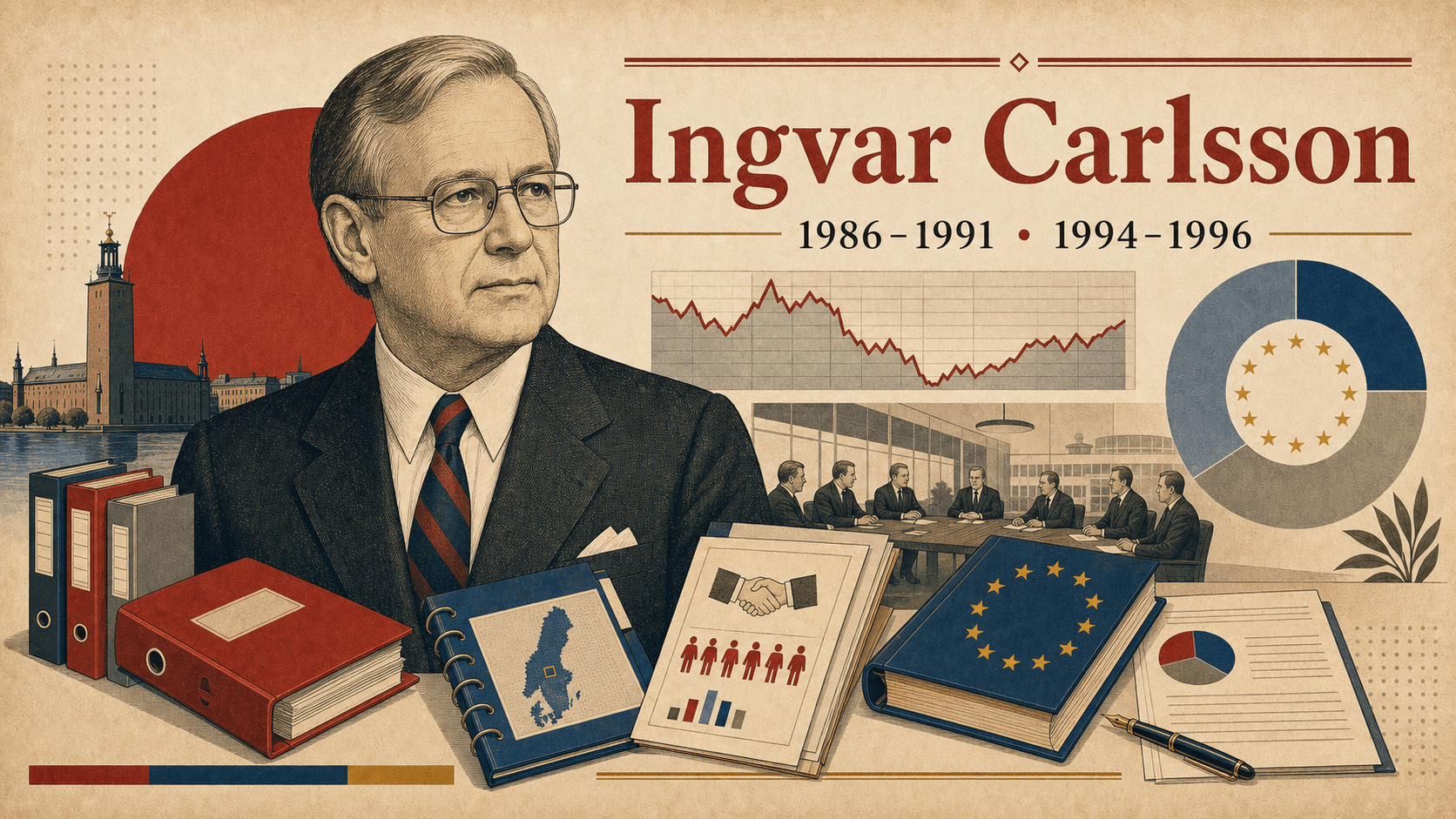
Ingvar Carlsson assumed the premiership within hours of Olof Palme‘s assassination on 28 February 1986 and delivered the funeral eulogy. The Carlsson I and II cabinets (1986–1991) governed through the immediate succession crisis, the 1988 Ebbe Carlsson affair — illegal parallel investigations into the Palme murder that forced Justice Minister Anna-Greta Leijon’s resignation — and the late-1980s neoliberal structural adjustments that abolished currency controls in 1989 and fed the credit bubble whose bursting in 1990 opened the Swedish banking crisis.
His first tenure ended at the 1991 general election, where Socialdemokraterna scored 37.71% — its worst result since 1928 — and lost government to the Moderate-led coalition under Carl Bildt. Carlsson stayed on as opposition leader during three years of bourgeois reform under deep banking-crisis conditions.
He returned to office in 1994 to lead the Carlsson III cabinet through the politically defining act of joining the European Union. Sweden’s accession on 1 January 1995 — see EU membership (1995) — closed the post-war neutrality compact and was the policy decision that most reshaped Swedish governance for a generation. The same period brought the Toblerone affair, in which Deputy PM Mona Sahlin’s misuse of a government credit card forced her resignation and ended her presumed succession to the Social Democratic leadership. Carlsson handed both the premiership and the SAP chairmanship to Göran Persson in 1996.