Arvid Lindman
Conservative Prime Minister of Sweden 1928–1930 (and earlier 1906–1911), heading a fragile late-1920s minority cabinet for Allmänna valmansförbundet/Högerpartiet — the historic predecessor of today's Moderaterna — through the year of the 1928 Collective Bargaining Agreements Act and the 1929 Wall Street crash.
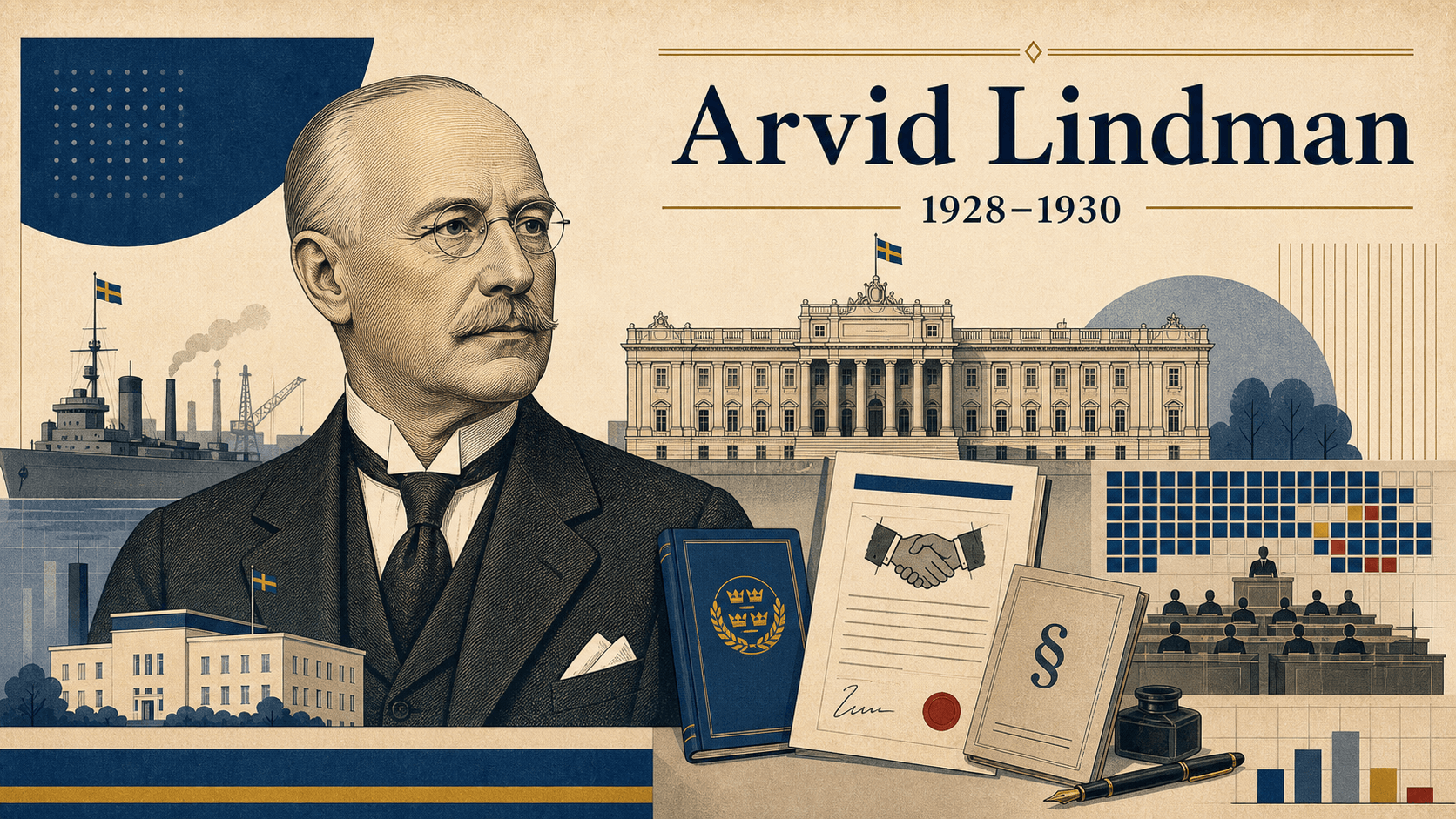
Arvid Lindman led a Conservative minority cabinet between 1928 and 1930 for Allmänna valmansförbundet/Högerpartiet, the historic right-wing party that would later evolve into today’s Moderaterna. The Folkhemmet Wikipedia entry, used as a control source in this pass, lists him among the key figures of “Conservatism in Sweden.”
His tenure straddled two episodes that shaped the rest of the interwar era. In 1928 the Collective Bargaining Agreements Act passed and the Swedish National Labour Court was set up over initial union opposition; in the same year his rival Per Albin Hansson — leader of Socialdemokraterna — gave the landmark Folkhemmet speech that would define the next half-century. The 1929 Wall Street crash struck during his second year in office, ending the run of fragile right-bloc minority cabinets and clearing the political ground for 1930‘s return of Liberalerna‘s Carl Gustaf Ekman.
Lindman’s brief second premiership is best read as the late-conservative bookend to the Sweden of 1920s minoritarian government — the moment just before the cross-class realignment of 1933 redrew the rules.