1974
Left bloc · SABBA wins Eurovision with 'Waterloo' and Sweden adopts its modern constitution.
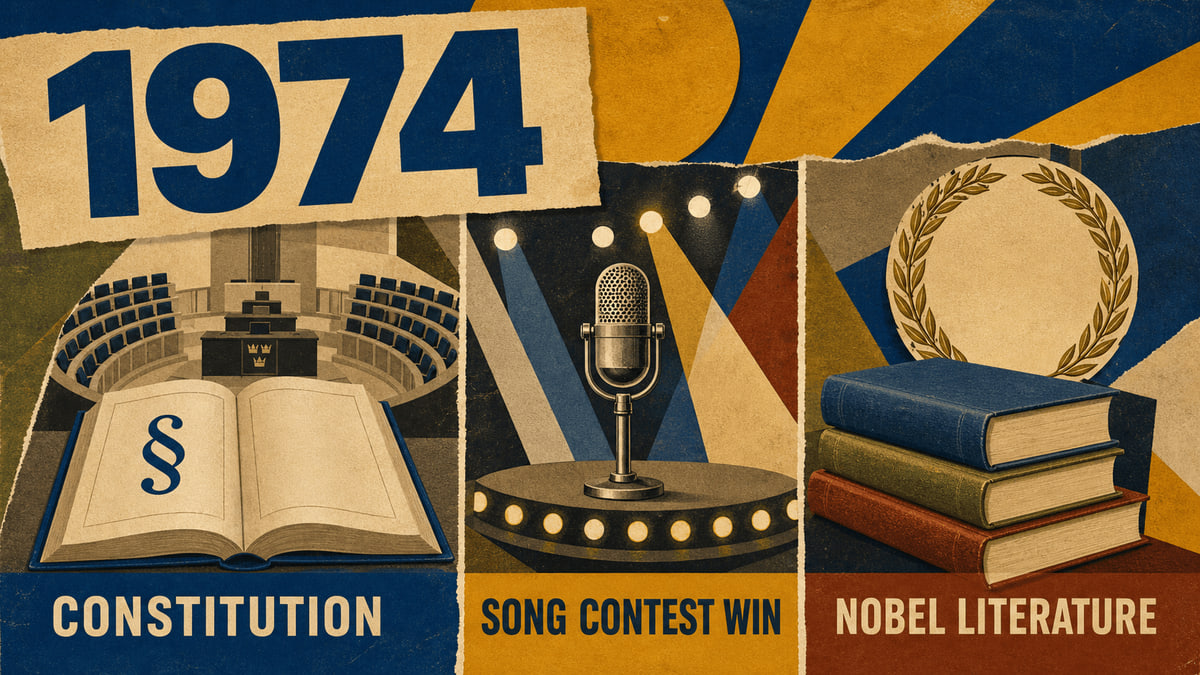
1974 infographic: constitution, song contest win, and Nobel literature
AI-generated infographic using the page's 1974 anchors.
Highlights
- ABBA at Eurovision: On 6 April 1974 in Brighton, ABBA won the Eurovision Song Contest with 'Waterloo', scoring 24 points — the first time a group rather than a solo artist had won the contest. The song hit number one across Europe and launched the band's decade-long global career.
- New Instrument of Government: The Riksdag adopted a new constitution (effective 1 January 1975) stripping the monarch of all remaining political powers and formally codifying parliamentary government for the first time. The Speaker of the Riksdag, not the king, would henceforth designate the Prime Minister.
- Dual Nobel in literature: The Nobel Prize in Literature was shared between Swedish authors Eyvind Johnson and Harry Martinson — sparking controversy because both were sitting members of the Swedish Academy that awards the prize.
Events in this year
1974 1974 Employment Protection Act (LAS) Olof Palme's first cabinet enacted the Employment Protection Act (Lagen om anställningsskydd, LAS) in 1974, the legal cornerstone of the Swedish labour model. The law imposed strict union-consultation rules, notice periods, valid-grounds requirements for dismissal, and the seniority-based priority rule — last in, first out — that would define internal labour markets for half a century. Reform 1974 ABBA wins Eurovision 1974 with Waterloo Eurovision records ABBA as the Brighton 1974 winner for Sweden with Waterloo, making 1974 legible as a cultural-export year as well as a constitutional year. Culture 1965-1974 Million Programme 1965 In 1965 the Riksdag adopted the Million Programme — a plan to build one million dwellings in Sweden over ten years. By 1974 roughly one million homes had been built; Olof Palme oversaw the project as Minister of Communications. It became, relative to population, the largest housing programme in the world at its time and the third corner of post-war Folkhemmet alongside 1947 welfare reforms and 1959 ATP. Reform