Consensus as Repair: How Sweden Split Apart for a Century and Put Itself Back Together
Swedes think of compromise as a national trait. In fact, it is a skill the country had to relearn after every major divide of the twentieth and twenty-first centuries — sometimes at the negotiating table, sometimes only after five people had been killed.
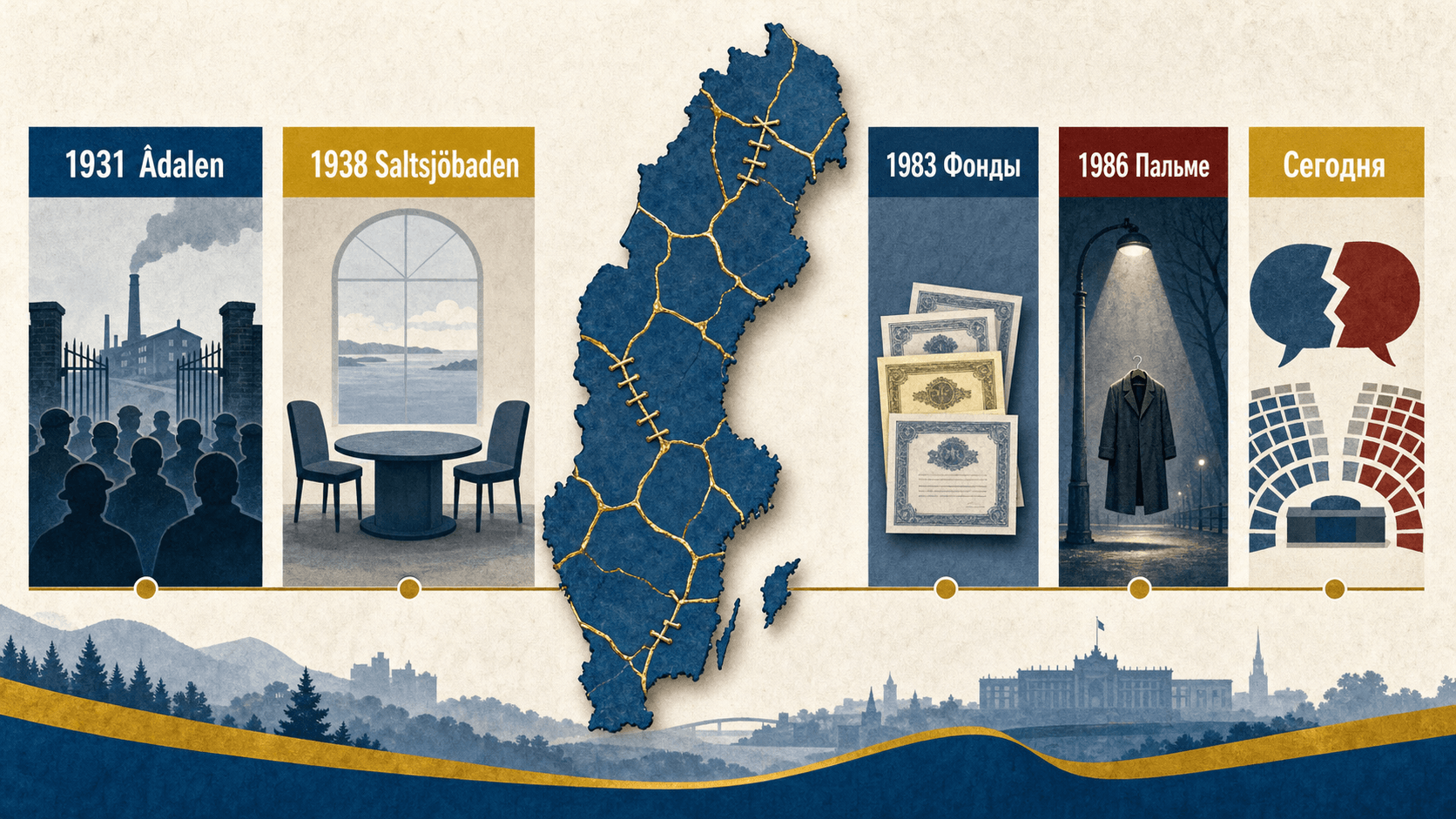
When people say that Sweden is more divided than ever, they usually assume that agreement is the country’s normal state and division a malfunction. Look at the past hundred years and the opposite appears. Division came regularly. Sweden’s famous consensus had to be invented again each time — and there was no guarantee that the next attempt would work.
This is more than wordplay. Whether calm is an inborn trait or an acquired skill changes the practical conclusion. A trait is either present or absent. A skill can be lost and restored — but only if you know how it is done and are prepared to work with your hands.
The myth and where it came from
The picture is familiar: a Swede avoids conflict, speaks quietly and answers every dispute with a working group and a compromise. Lagom — just enough, never extreme. This self-portrait exists, and it contains some truth. The problem is its date. It is often treated as ancient, a product of nature and climate, when its current form emerged at a specific time: the first half of the twentieth century, as a deliberate answer to events that looked nothing like tranquillity.
Two dates are enough to see it: 1931 and 1938. Seven years contain the entire distance between a country that fires on its own people and one that turns negotiation into a national religion.
1931: Ådalen, the low point
In the spring of 1931, a prolonged labour dispute gripped the sawmill district of Ådalen in northern Sweden amid depression and high unemployment. Strikers confronted strikebreakers protected by police, and tensions rose. Local authorities called in the army. On 14 May, soldiers opened fire on a peaceful workers’ march. Five people were killed and several wounded.
Outrage swept the country. The inquiry that followed condemned the use of troops in a labour dispute. Ådalen remains the bloodiest episode in the history of the Swedish labour movement and entered the national memory for good, not least through Bo Widerberg’s film Ådalen 31.
Two consequences reach beyond the tragedy. First, Ådalen became the “never again” against which consensus in the Swedish model was built a few years later: a symbolic anti-example. Second, it established in practice a norm that still holds — the armed forces are not used in labour disputes. It also increased support for the Social Democrats, whose long era in power began with their 1932 election victory.
1938: Saltsjöbaden, a peace assembled by hand
On 20 December 1938, at the Grand Hotel in the resort of Saltsjöbaden outside Stockholm, the LO trade-union confederation and the SAF employers’ association signed a framework agreement. It set detailed rules for industrial action, redundancies and dispute resolution and created a joint labour-market body.
The crucial detail is how it was reached. The state did not dictate the terms. The red-green government of Per Albin Hansson merely made clear that if the parties did not agree, legislation would settle matters for them. Faced with that threat, LO and SAF chose self-regulation over compulsion and signed the peace voluntarily.
This was the origin of the “Spirit of Saltsjöbaden”, saltsjöbadsandan: the habit of resolving conflicts over distribution through top-level negotiation. The result can be measured. In the 1920s, Sweden had one of Europe’s most strike-prone economies. From the 1940s through the 1970s, it had one of the calmest. The Rehn–Meidner wage policy and the post-war “record years” of growth rose on that foundation.
This deserves a pause. Sweden’s celebrated consensus did not precede Ådalen. It appeared after Ådalen, as a remedy. It was assembled by hand, like furniture, in rather luxurious surroundings: a class war that had recently ended in bodies was reconciled in a hotel by the water.
Saltsjöbaden did not come from nowhere. It followed the 1928 Collective Agreements Act and the 1933 “Cow Trade”, the agreement with the Agrarian Party that kept the Social Democratic government in office. In other words, 1938 was the symbolic summit of a process, not a solitary miracle. It was that summit, however, that later came to be remembered as a national character trait.
1976–1983: the cold divide over the funds
Forty years later, Sweden’s talent for agreement failed again — this time without gunfire, but seriously and for years.
Trade-union economist Rudolf Meidner proposed what became known as the Meidner Plan. A share of large companies would gradually pass into collective wage-earner funds through levies on profits. The project was called “economic democracy”: over time, employees would become co-owners of the companies they worked for. The left saw the logical continuation of the Swedish model. Business saw the end of private ownership in Sweden.
The conflict grew for several years. It culminated on 4 October 1983, when between 75,000 and 100,000 business owners and managers marched to the Riksdag, depending on the estimate. It was the largest demonstration by the political right in modern Swedish history. The funds were still adopted that year, but in such a diluted form that almost nothing remained of Meidner’s original proposal. In 1991, Carl Bildt’s government quietly abolished them.
The consequence mattered more than the outcome. The struggle turned Swedish business into an organised political movement with institutions of its own, including Timbro, and shifted the cultural ground to the right for the decade that followed. A project the Social Democrats imagined as unifying became toxic and split the country. Years later, few people on either left or right can explain in two sentences what brought 100,000 people into the streets. The division was real; its object evaporated. That is useful to remember when today’s disputes feel eternal.
1986: a break without reconciliation
Not every division ends in a pact. Any honest account has to include that.
On the evening of 28 February 1986, prime minister Olof Palme was shot dead on a street in central Stockholm. He had no bodyguard and was walking home from the cinema. This was not a class conflict or a dispute about ownership. But it was the point at which Sweden stopped imagining itself as a quiet backwater beyond the reach of history. The case remains unsolved, and the unclosed wound is still part of the country’s nervous system. There was no Saltsjöbaden here, not even a diluted compromise — only a break that was never repaired.
2015 and after: a new seam
Today’s crack no longer follows the line between workers and owners. It concerns belonging: who “we” are, whom the country regards as one of its own and what to do about migration.
After the large refugee arrivals of 2015, the issue rearranged the whole political field. The establishment had kept the Sweden Democrats behind a cordon sanitaire for decades and refused to deal with them. The isolation gradually weakened. By 2022, the Tidö Agreement had made the party the parliamentary support of a right-wing government. A cordon many had regarded as permanent collapsed, just as class peace and the Social Democrats’ monopoly on power had once seemed permanent.
Add the disturbances in the suburbs — Gothenburg in 2001, Husby in 2013 — and the crises around public Quran burnings, and the new division looks no less severe than the class conflict. It simply runs along a different seam, for which no ready-made reconciliation exists.
What follows from this
Set these episodes next to each other and the same movement appears. Every generation of Swedes was convinced that its division was final and beyond repair. Each time, agreement was not recovered as a forgotten virtue. It had to be assembled again, usually after the country had looked over the edge.
That gives us a practical conclusion, which is what makes the history useful rather than merely interesting. A “calm Sweden” is not something the country possesses by nature. It is something the country has managed to make several times. Temperament would come free. Repair has to be done by hand each time, with no guarantee that it will work again.
The useful question about today’s division is therefore not “who is to blame?” It is whether the present tension is leading towards a new Saltsjöbaden, or only towards the break that usually comes before such a pact. Most importantly: are there still people in the country who know how to sit down at a table when everyone else is certain there is no one left to negotiate with?
How we frame this. This is popular history, not an academic paper, and the scheme has a weakness: the episodes were selected in a way that forms a “break → pact” arc. That is why it deliberately includes cases that do not fit — Palme’s murder in 1986, where no reconciliation followed, and the open divide over migration, whose outcome is still unknown. “Consensus was invented in 1938” should be read with a qualification: Saltsjöbaden was the symbolic peak of a process — the 1928 Act, the 1933 “Cow Trade” — not its only moment.