1941
Left bloc · SLaw expanded.
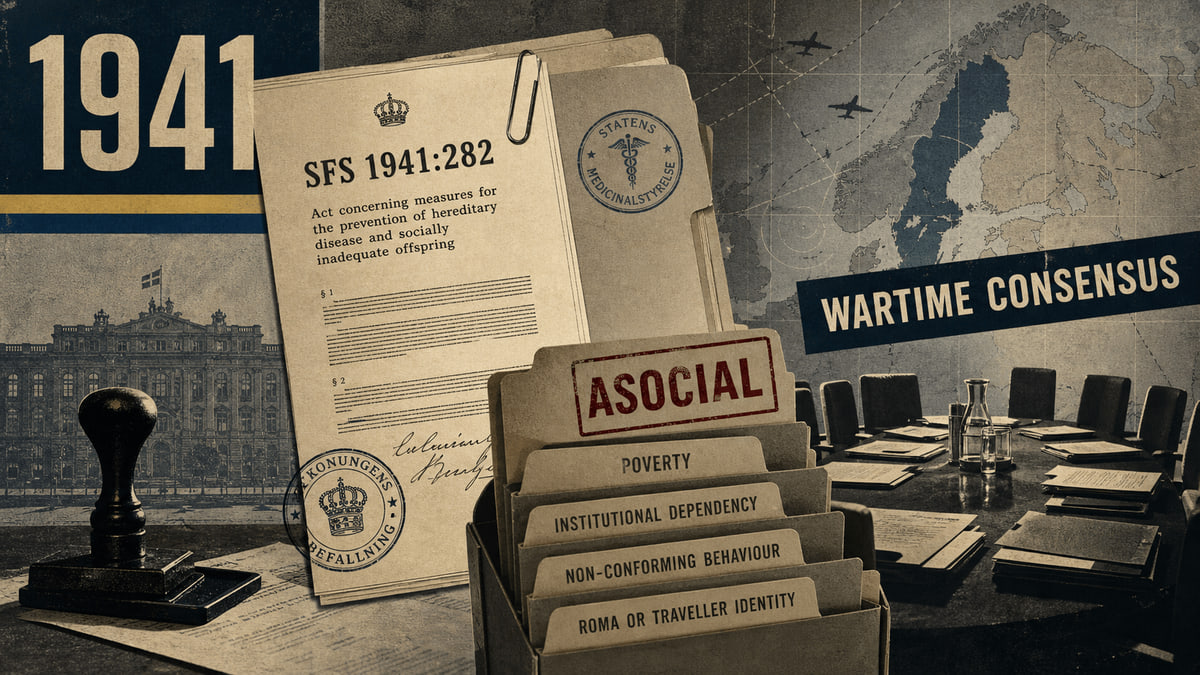
1941 illustration: SFS 1941:282 and wartime consensus
1940s wartime utility-print illustration of the expanded sterilization law, asocial category, and all-party government context. Generated image, not source evidence.
Highlights
- Law of 1941: Sweden passed SFS 1941:282, replacing the 1934 law with a wider framework that added people classified as 'antisocial'.
- Social labels: The broad category reached people marked by poverty, institutional dependency, non-conforming behaviour, and Roma or Traveller identity.
- Wartime consensus: The expansion passed under Per Albin Hansson's all-party wartime government while Germany's forced sterilization programme was already running.
Events in this year
1939-12-13 1939 Formation of the National Unity Government After the German invasion of Poland and the Soviet attack on Finland in autumn 1939, Per Albin Hansson dissolved his red-green coalition and formed a National Unity Government — the samlingsregering — that took office on 13 December 1939 and governed Sweden until the end of World War II. The cabinet included all four major Riksdag parties but excluded the Communists; its mission was strict neutrality, wartime supply management, and rapid military rearmament. Crisis 1941 En svensk tiger becomes a wartime vigilance icon Bertil Almqvist's 1941 yellow-and-blue tiger became an iconic image of Sweden's wartime vigilance campaign, linking culture, silence, security, and public duty. Culture 1941 Expanded Sterilization Law 1941 In 1941 Sweden's all-party wartime government passed SFS 1941:282, expanding the 1934 sterilization law to cover 'antisocial' individuals — a category applied to Roma, people with persistent welfare dependency, and those deemed socially non-conforming — while Nazi Germany's own forced sterilization programme was running. Reform 1941 Gunder Hägg fever and wartime running records Gunder Hägg's 1941-1945 world-record streak, especially the ten records of summer 1942, became a wartime sports and radio phenomenon in Sweden. Sports 1939-1945 Beredskapstiden and Everyday Wartime Life 1939-1945 Sweden avoided combat in the Second World War, but beredskapstiden reshaped daily life through rationing, shortages, preparedness routines, and a public culture of crisis discipline. Culture 1941-06 Midsummer Crisis 1941 Midsummer Crisis: Following Operation Barbarossa (22 June 1941), Germany and Finland demanded rail transit for the Wehrmacht's 163rd Infantry Division through Sweden from Norway to Finland. Per Albin Hansson's government agreed — a clear breach of international neutrality law. Crisis