1942
Left bloc · SIron ore flows to Germany while Allied pressure mounts.
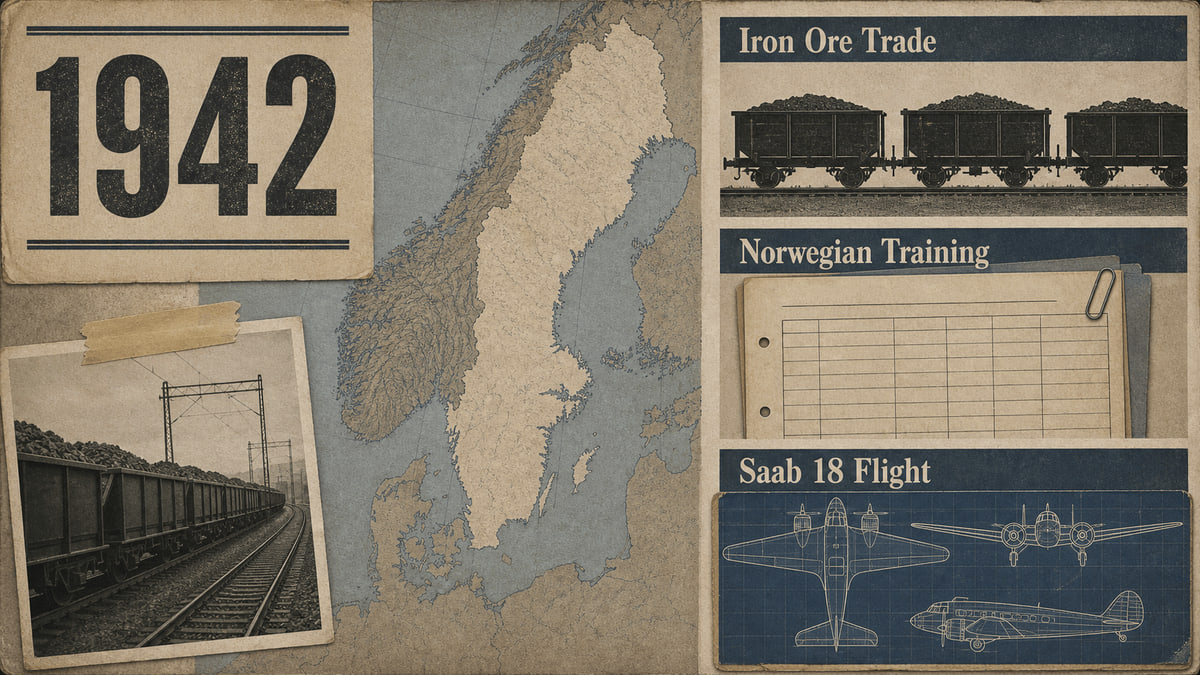
1942 infographic: iron ore trade, Norwegian training, and the Saab 18 flight
AI-generated infographic using the page's 1942 anchors.
Highlights
- Iron ore exports peak: Sweden supplied roughly ten million tons of iron ore to Germany in 1942 — the war's most strategically significant Swedish concession. Allied diplomatic pressure to halt shipments intensified but the government held firm, citing the need to avoid invasion.
- Norwegian police training begins: The first covert training courses for Norwegian police officers were quietly permitted on Swedish soil, laying the groundwork for the larger programme of clandestine military preparation that would expand from 1943.
- Saab 18 first flight: The twin-engine Saab 18 medium bomber made its maiden flight on 19 June 1942, affirming Sweden's growing capacity for domestic military aircraft production.
Events in this year
1939-12-13 1939 Formation of the National Unity Government After the German invasion of Poland and the Soviet attack on Finland in autumn 1939, Per Albin Hansson dissolved his red-green coalition and formed a National Unity Government — the samlingsregering — that took office on 13 December 1939 and governed Sweden until the end of World War II. The cabinet included all four major Riksdag parties but excluded the Communists; its mission was strict neutrality, wartime supply management, and rapid military rearmament. Crisis 1941 En svensk tiger becomes a wartime vigilance icon Bertil Almqvist's 1941 yellow-and-blue tiger became an iconic image of Sweden's wartime vigilance campaign, linking culture, silence, security, and public duty. Culture 1941 Gunder Hägg fever and wartime running records Gunder Hägg's 1941-1945 world-record streak, especially the ten records of summer 1942, became a wartime sports and radio phenomenon in Sweden. Sports 1942 Iron ore exports peak 1942 Iron ore exports peak: Sweden supplied roughly ten million tons of iron ore to Germany in 1942 — the war's most strategically significant Swedish concession. Allied diplomatic pressure to halt shipments intensified but the government held firm, citing the need to avoid invasion. Foreign policy 1939-1945 Beredskapstiden and Everyday Wartime Life 1939-1945 Sweden avoided combat in the Second World War, but beredskapstiden reshaped daily life through rationing, shortages, preparedness routines, and a public culture of crisis discipline. Culture