1943
Left bloc · SSweden pivots: German transit halted, Norwegian troops trained openly.
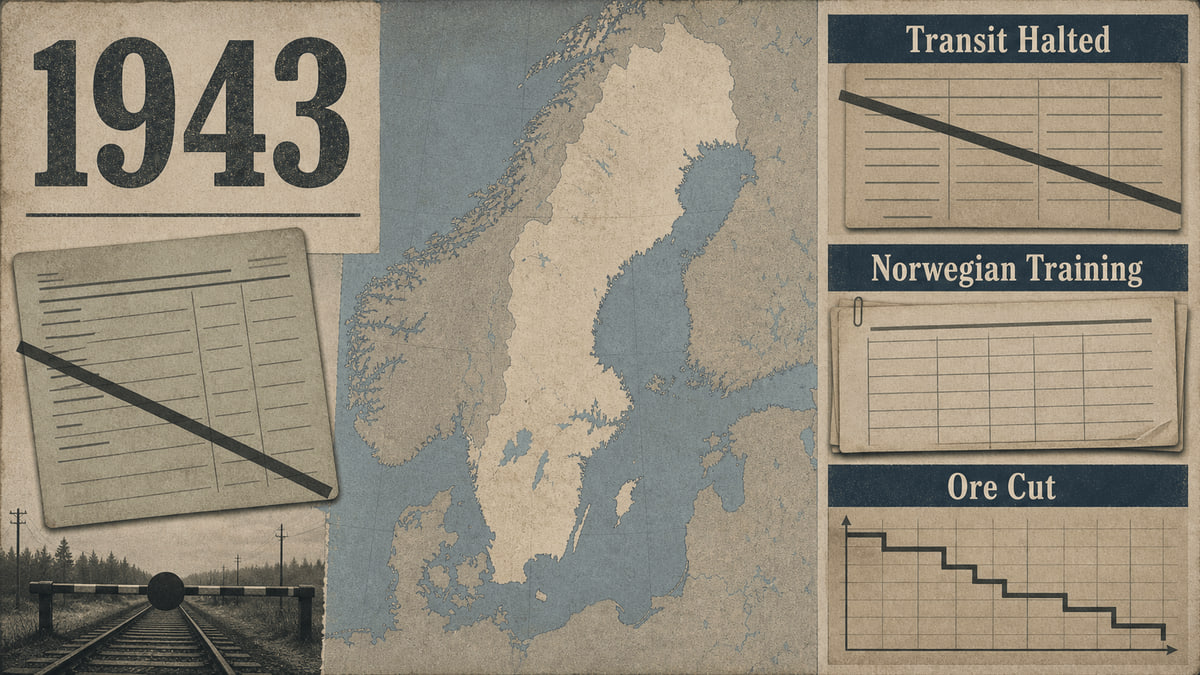
1943 infographic: transit halted, Norwegian training, and ore cuts
AI-generated infographic using the page's 1943 anchors.
Highlights
- Permittenttrafik terminated: As Germany suffered defeats at Stalingrad and El Alamein, Swedish public opinion shifted decisively. On 29 June 1943 the cabinet announced that transit of German leave-soldiers (Permittenttrafik) would cease by October — a major policy reversal after three years of concession.
- Norwegian troop training authorised: On 3 December 1943 the Swedish government officially sanctioned training of 8,000 reserve troops and 1,500 Norwegian police on Swedish soil — a covert military force for Norway's eventual liberation.
- Iron ore exports cut: A September 1943 agreement with the Allies committed Sweden to reducing annual iron ore deliveries to Germany from roughly 9.5 million to 7 million tons in 1944.
Events in this year
1939-12-13 1939 Formation of the National Unity Government After the German invasion of Poland and the Soviet attack on Finland in autumn 1939, Per Albin Hansson dissolved his red-green coalition and formed a National Unity Government — the samlingsregering — that took office on 13 December 1939 and governed Sweden until the end of World War II. The cabinet included all four major Riksdag parties but excluded the Communists; its mission was strict neutrality, wartime supply management, and rapid military rearmament. Crisis 1941 En svensk tiger becomes a wartime vigilance icon Bertil Almqvist's 1941 yellow-and-blue tiger became an iconic image of Sweden's wartime vigilance campaign, linking culture, silence, security, and public duty. Culture 1941 Gunder Hägg fever and wartime running records Gunder Hägg's 1941-1945 world-record streak, especially the ten records of summer 1942, became a wartime sports and radio phenomenon in Sweden. Sports 1939-1945 Beredskapstiden and Everyday Wartime Life 1939-1945 Sweden avoided combat in the Second World War, but beredskapstiden reshaped daily life through rationing, shortages, preparedness routines, and a public culture of crisis discipline. Culture 1943-06-29 Permittenttrafik terminated 1943 Permittenttrafik terminated: As Germany suffered defeats at Stalingrad and El Alamein, Swedish public opinion shifted decisively. On 29 June 1943 the cabinet announced that transit of German leave-soldiers (Permittenttrafik) would cease by October — a major policy reversal after three years of concession. Foreign policy 1943-10 Rescue of Denmark's Jews to Sweden in 1943 In October 1943, most Danish Jews escaped to neutral Sweden; USHMM estimates that about 7,200 Jews and 700 non-Jewish relatives reached safety. Foreign policy