1944
Left bloc · SSoviet bombs fall on Stockholm; Wallenberg saves thousands in Budapest.
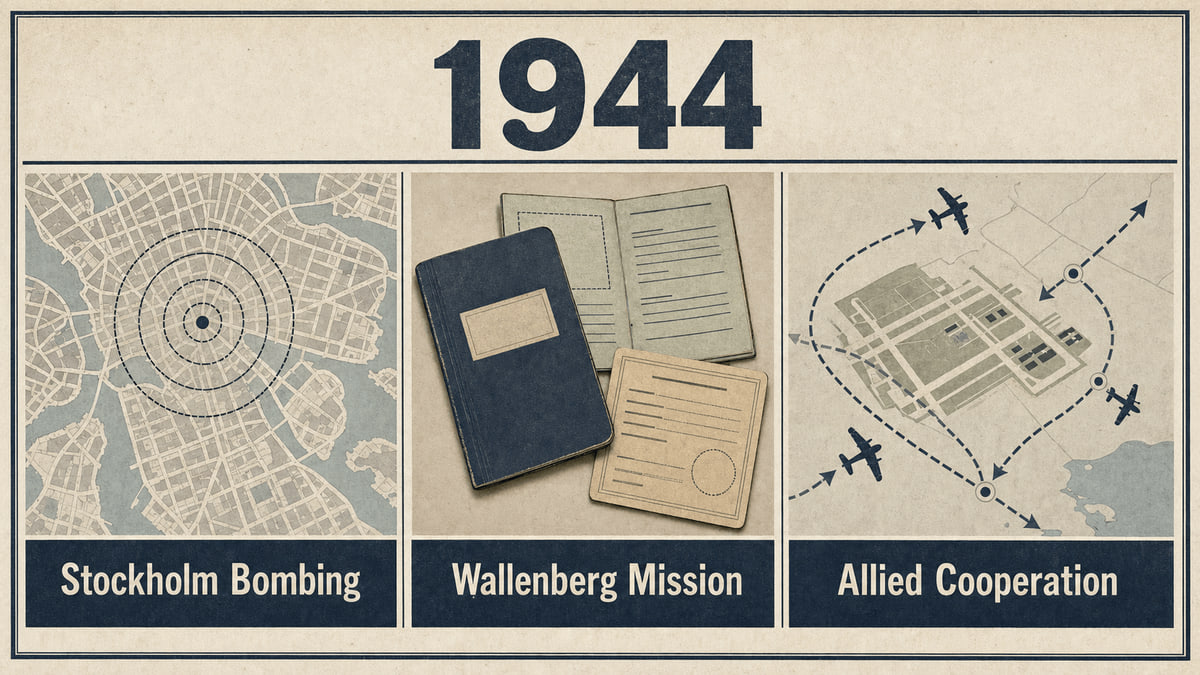
1944 infographic: Stockholm bombing, Wallenberg mission, and Allied cooperation
AI-generated infographic using the page's 1944 anchors.
Highlights
- Soviet bombing of Stockholm: During the night of 22–23 February 1944, Soviet aircraft dropped bombs on Stockholm's Södermalm district and on Strängnäs, injuring several people. The USSR denied responsibility, attributing the raid to navigational error; notably, a Soviet spy held in Stockholm was released four days later.
- Raoul Wallenberg's mission: Swedish diplomat Raoul Wallenberg arrived in Budapest in July 1944. By December he had issued protective Swedish passports and established safe houses, saving an estimated tens of thousands of Hungarian Jews from Nazi deportation.
- Full Allied alignment: Sweden allowed Allied use of Swedish airfields and expanded secret training of Norwegian and Danish forces on its soil, completing the wartime shift from German accommodation to Allied cooperation.
Events in this year
1939-12-13 1939 Formation of the National Unity Government After the German invasion of Poland and the Soviet attack on Finland in autumn 1939, Per Albin Hansson dissolved his red-green coalition and formed a National Unity Government — the samlingsregering — that took office on 13 December 1939 and governed Sweden until the end of World War II. The cabinet included all four major Riksdag parties but excluded the Communists; its mission was strict neutrality, wartime supply management, and rapid military rearmament. Crisis 1941 En svensk tiger becomes a wartime vigilance icon Bertil Almqvist's 1941 yellow-and-blue tiger became an iconic image of Sweden's wartime vigilance campaign, linking culture, silence, security, and public duty. Culture 1941 Gunder Hägg fever and wartime running records Gunder Hägg's 1941-1945 world-record streak, especially the ten records of summer 1942, became a wartime sports and radio phenomenon in Sweden. Sports 1939-1945 Beredskapstiden and Everyday Wartime Life 1939-1945 Sweden avoided combat in the Second World War, but beredskapstiden reshaped daily life through rationing, shortages, preparedness routines, and a public culture of crisis discipline. Culture 1944-07-09 Raoul Wallenberg's Budapest Mission 1944 In July 1944 Swedish diplomat Raoul Wallenberg was dispatched to Nazi-occupied Hungary on a humanitarian rescue mission coordinated with the US War Refugee Board. Operating from the Swedish legation in Budapest, he issued protective passes and set up "Swedish houses" that sheltered tens of thousands of Hungarian Jews. He disappeared into Soviet custody on 17 January 1945 — Sweden's defining act of active wartime humanitarianism and one of its longest-running diplomatic disputes with Moscow. Foreign policy 1944-11 Safehaven pressure and Sweden's break with German wartime trade By late 1944, Allied Safehaven and economic-warfare pressure put Sweden's German trade, assets, and neutral financial channels under sharper scrutiny. Economy