Hjalmar Branting
Founder of the Swedish Social Democratic Party (SAP), first Social Democrat to serve as Prime Minister of Sweden (three short cabinets in 1920, 1921-1923, 1924-1925), co-recipient of the 1921 Nobel Peace Prize, and the principal organiser of universal suffrage reform that opened the long Folkhemmet era to come.
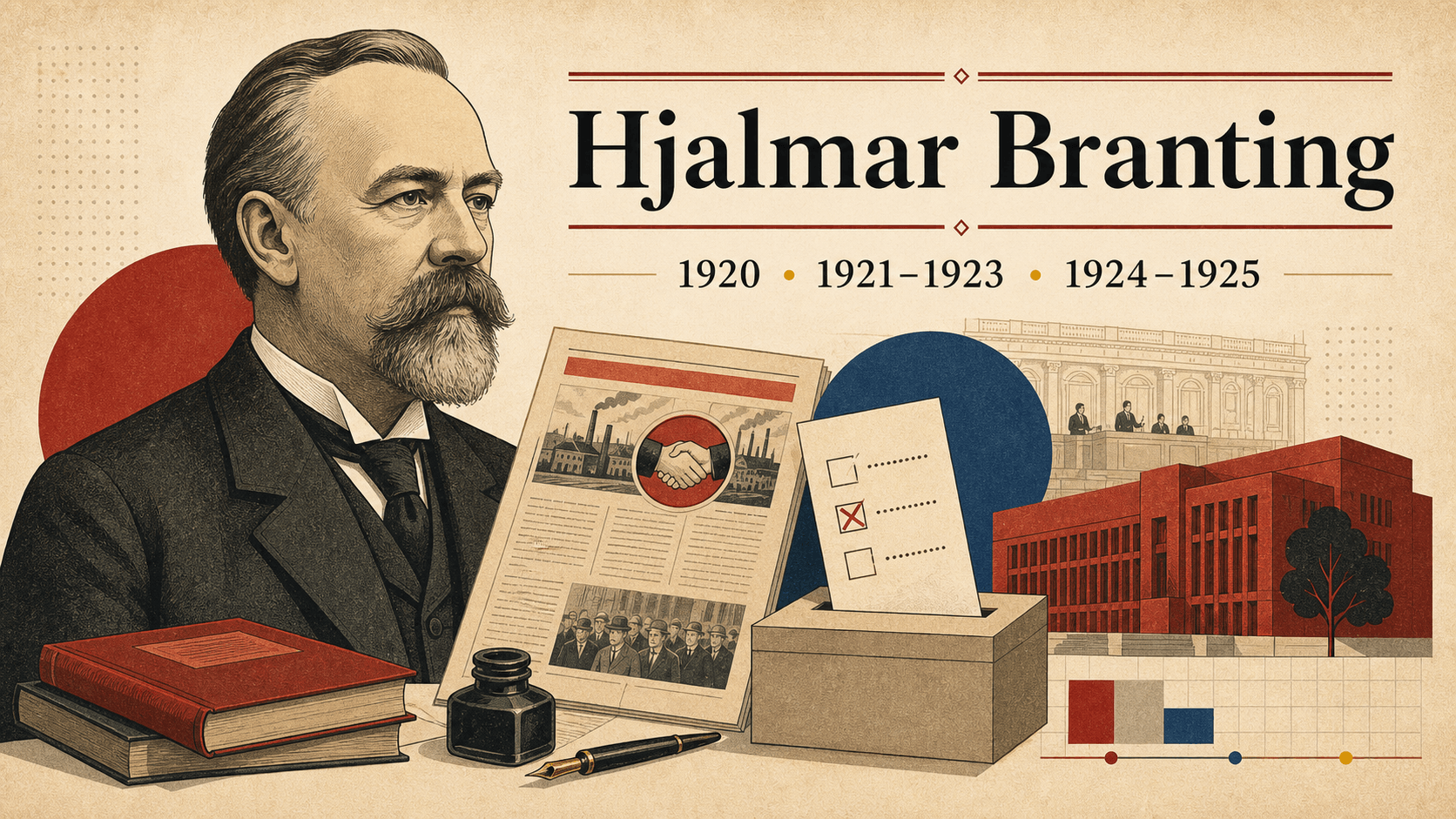
Hjalmar Branting co-founded the Swedish Social Democratic Party in 1889 and built it from a printers’-union project into the dominant party of the Swedish 20th century. He served as the first Social Democrat in a Swedish cabinet (Finance, 1917) and then as Prime Minister in three short cabinets in 1920, 1921-1923, and 1924-1925 before his death in office in February 1925.
Branting’s politics combined parliamentary reformism with the strike weapon. He argued from the 1890s that democracy and labour organisation were the path to socialism and resisted both syndicalist and Bolshevik alternatives — a fight that, in 1917, produced a left split (the future Vänsterpartiet). His cabinets implemented the constitutional reforms of 1918-1921 that brought universal male and female suffrage to both chambers of the Riksdag.
In 1921 Branting shared the Nobel Peace Prize with Norway’s Christian Lange, recognising his work for the League of Nations and the peaceful dissolution of the Sweden-Norway union. He died on 24 February 1925, succeeded by Rickard Sandler. The Folkhemmet that Per Albin Hansson and Tage Erlander would later build stood on the constitutional and party-organisational foundations Branting had laid.